
🎧 Listen to this article: हिंदी · English · தமிழ் · తెలుగు · ಕನ್ನಡ · മലയാളം · ଓଡ଼ିଆ · 日本語 · 中文
🌍 Read this in your language: हिंदी · தமிழ் · తెలుగు · ಕನ್ನಡ · മലയാളം · ଓଡ଼ିଆ · 日本語 · 中文
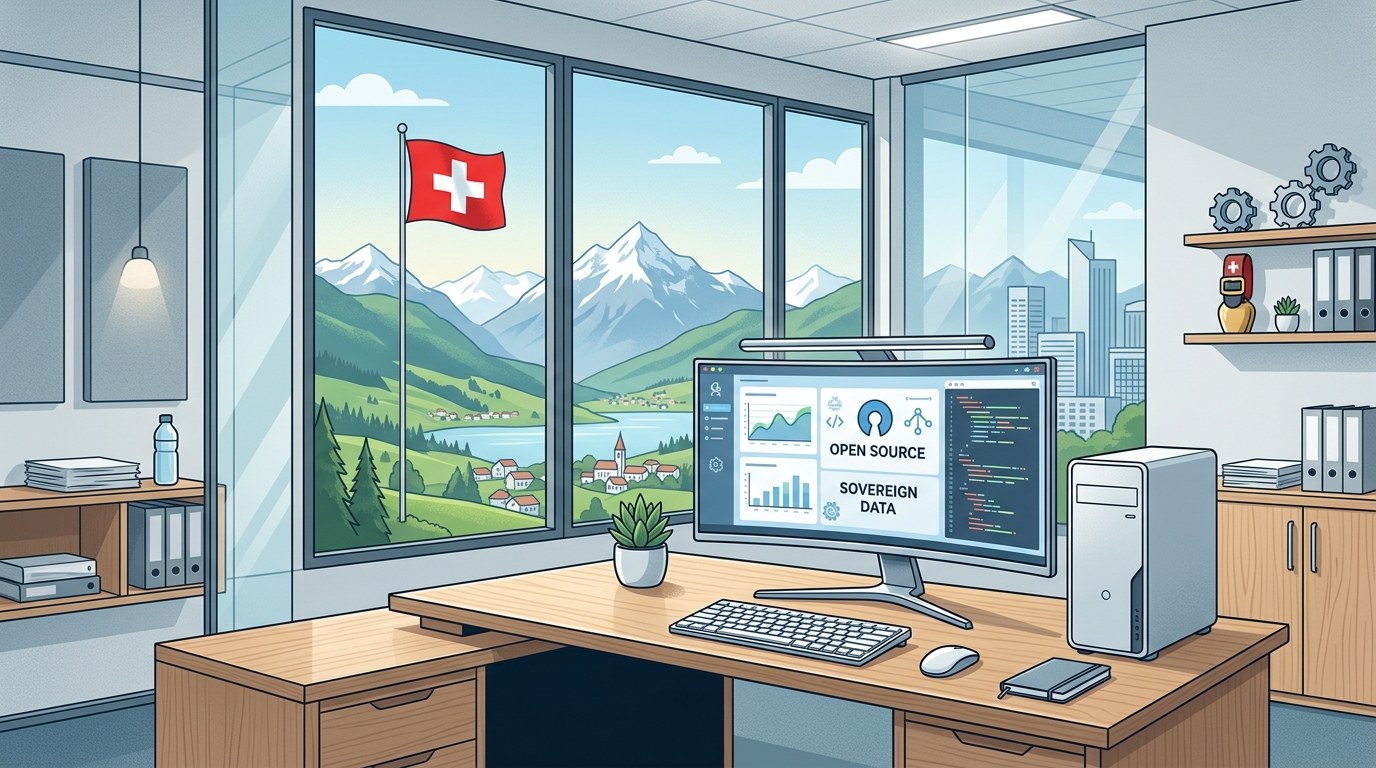
On September 3, 2026, Switzerland's Federal Council published the results of a pilot that open-source advocates have wanted a national government to attempt at real scale for a long time: replacing Microsoft 365 on thousands of government computers with open-source software.
Today is September 7, 2026, and this story is worth slowing down for, because it is not just a Swiss IT decision. It is a live demonstration of an argument that Dr. A.P.J. Abdul Kalam, then President of India, made to a room full of Indian software professionals back in 2003, and made again in far more detail in a 2010 speech that most people have never read in full. Switzerland is now doing, at government scale, the exact thing he was asking for.
What Switzerland is actually doing
The Swiss Federal Chancellery ran a proof-of-concept called PoC BOSS with 172 federal employees, testing whether they could do their daily work — documents, email, collaboration — on openDesk, a German-built, open-source workplace suite, instead of Microsoft 365. The employees rated document editing and email positively. Large-scale video conferencing still had rough edges.
Based on those results, the government is now moving into a pilot covering 3,000 workstations, roughly 7 percent of its federal workforce, out of about 54,000 computers total. The Federal Chancellery is putting CHF 9 million behind it, and the plan runs in parallel with the existing Microsoft setup so nobody's work stops if something breaks. The target for judging whether it should scale further is the end of 2027. Switzerland's military Cyber Command is moving even faster, aiming to fully replace Microsoft by October 2026.
This isn't a sudden ideological swing. It follows a 2024 law, EMBAG, that already requires Swiss federal agencies to publish government-built software as open source by default. In December 2025, the Federal Council named digital sovereignty a top policy priority, defined plainly as the government's ability to do its job without depending on a single outside supplier or country. Researchers close to the project point to three concrete worries driving it: foreign legal reach into Swiss government data through US cloud laws, the risk of being stuck with one vendor's roadmap and pricing, and licensing costs that keep climbing with no room to negotiate.
An Indian president said this first, in public, in 2003
In May 2003, President Kalam spoke at the International Institute of Information Technology in Hinjawadi, Pune, and told the assembled IT industry to develop and specialize in open-source software rather than build careers around proprietary platforms like Microsoft Windows. He referenced, openly, his own disagreements with Microsoft's Bill Gates on the subject and pointed people to his official website to read the full text.
The room did not brush this off. The president of the Software Exporters Association of Pune said the cost argument alone made open source essential for India, since the country could not run mass computerization on software bought from the United States. The director of the Software Technology Parks of India said his own organization was already moving its platform to Linux. The advisory chairman of IIIT, who had earlier led India's supercomputer program at C-DAC, said open source would matter enormously for education, governance, and social-sector computing at scale. One CEO put it bluntly: China was already doing it, so there was no real reason India shouldn't.
That was more than two decades ago. A national government seriously piloting exactly this — not a company, not a university department, but the federal apparatus of a wealthy country — is what is happening in Switzerland right now.
The fuller vision, from 2010
Kalam returned to this theme in 2010 at the National Convention for Academics and Research in Hyderabad, and this speech is where he got specific about what India was getting wrong.
He pointed to Bharathi OS, an open-source operating system effort led by India's Centre for Development of Advanced Computing, and asked, directly, why it had seen far less adoption than expected. His answer was not "open source doesn't work." His answer was that India kept treating open source as a technical exercise instead of building a product people actually wanted to standardize on.
He used Android as the counterexample. By late 2010, Android ran on a modified Linux kernel, was backed by a 79-member industry alliance, had over 100,000 apps, and had already taken the largest share of US smartphone sales that year. Its code, some 12 million lines across Java, C, C++, and XML, was released under the Apache license. His point: open source only becomes transformative once it is value-added into something reliable enough, usable enough, and interoperable enough that hardware makers and ordinary users choose it over the proprietary alternative — not because it's free, but because it's better.
He also cited two Indian efforts as proof this was achievable domestically. Wikipedia showed that a community could build and maintain a knowledge resource used worldwide with no commercial motive behind it. Closer to home, the Open Source Drug Discovery program, led by India's Council of Scientific and Industrial Research, got roughly 800 researchers from India and abroad to re-annotate the tuberculosis bacterium's genome — a task experts had estimated would take 300 person-years — in four months, by opening the problem up the way software projects open up their code.
His closing challenge was for India to stop importing solutions and instead build a branded, government-and-industry-backed open system that could serve a billion people directly, the same way Android had reshaped mobile computing for everyone else.
Why Switzerland's approach answers Kalam's original question
Read the two speeches together, and Switzerland's 2026 pilot looks like a direct answer to the gap Kalam identified in 2010. Bharathi OS struggled partly because it was a standalone technical project without a strong adoption push behind it. Switzerland avoided that mistake in three visible ways.
Step 1: Test with real users before committing anything
Switzerland ran its pilot with 172 real federal employees doing real daily work, not a lab demo, and published the honest results — including where the open-source suite still lags, like large video calls. Kalam's speeches never got this specific because Bharathi OS never got a pilot at this scale to report on.
Step 2: Adopt a maintained platform instead of building one from zero
Rather than inventing a new operating system, Switzerland is deploying openDesk, an existing, actively maintained open-source suite already used elsewhere in Europe. This mirrors Kalam's own Android argument: the win came from adopting and improving an existing open base, not starting over.
Step 3: Back it with law and budget, not just goodwill
EMBAG made open-source-by-default the legal baseline for Swiss government software in 2024, and the Federal Council made digital sovereignty an official priority in December 2025, with real money (CHF 9 million) attached. Kalam's 2003 and 2010 remarks were persuasive speeches; they were never backed by a comparable Indian law or budget line at that scale.
Conclusion
Switzerland's 3,000-computer pilot is not a radical new idea. It is a national government finally executing, with a law, a budget, and a real pilot group, an argument an Indian president made in public in 2003 and refined in 2010: that open-source software, treated as a serious product rather than a hobby project, can replace proprietary platforms at institutional scale. Whether Switzerland's pilot succeeds by the end of 2027 will say a lot about whether the rest of the world follows.
Merits
- Reduces single-vendor dependency and gives governments real negotiating leverage on licensing costs.
- Lowers exposure to foreign legal reach over government data stored with a single overseas cloud provider.
- Uses an already-maintained platform (openDesk) rather than reinventing infrastructure from scratch.
- Runs as a parallel pilot, so existing work is not disrupted if problems appear.
- Sets a public, reviewable precedent other governments can study before committing their own budgets.
Demerits
- Collaboration tools built for large organizations, like enterprise-scale video conferencing, are still catching up to proprietary equivalents.
- Migrating any large workforce off familiar software has a real retraining and productivity cost during the transition.
- A CHF 9 million pilot covering 3,000 of 54,000 computers is still a small fraction of the full federal estate; scaling it is a much bigger undertaking.
- Success depends on sustained political and budget commitment across multiple years, which can change with elections or priorities.
Caution
This article is educational and summarizes publicly reported information about a government technology pilot and historical speeches; it is not a recommendation to migrate any specific organization's infrastructure. Any organization considering a similar move should run its own pilot, verify current facts and timelines directly from official sources, and test thoroughly before relying on open-source alternatives in production.
Frequently asked questions
- Why is Switzerland replacing Microsoft on government computers? — To reduce dependence on a single foreign vendor, lower long-term licensing costs, and limit exposure to foreign data-access laws affecting cloud services.
- What software is replacing Microsoft 365 in Switzerland's pilot? — openDesk, an open-source workplace and collaboration suite originally built in Germany.
- How many computers are involved in the Swiss pilot? — About 3,000 workstations, roughly 7 percent of the federal government's approximately 54,000 computers.
- What is Switzerland's EMBAG law? — A 2024 Swiss law requiring federal agencies to publish government-developed software as open source by default.
- Did Dr. Kalam ever publicly criticize Microsoft? — In a 2003 speech in Pune, he urged Indian IT professionals to focus on open-source software over proprietary platforms like Windows and referenced his own disagreements with Microsoft's Bill Gates on the issue.
- What was Bharathi OS? — An open-source operating system effort led by India's Centre for Development of Advanced Computing, which Kalam cited in 2010 as an example of open source that saw less adoption than hoped.
- What is Open Source Drug Discovery (OSDD)? — An Indian, CSIR-led research program that used open collaboration among hundreds of researchers to accelerate tuberculosis drug research, cited by Kalam as proof the open-source model works beyond software.
- Is digital sovereignty the same as data privacy? — No. Digital sovereignty is broader — it refers to a government's or organization's ability to run its own systems without depending on an external supplier or country, which includes but isn't limited to data privacy.
Tags
#OpenSource #DigitalSovereignty #Linux #GovTech #Switzerland #APJAbdulKalam #TechPolicy #Android #DataPrivacy #India
API Security Testing Checklist
A practical workflow for testing authentication, authorization, input handling, business logic, and evidence without losing track of scope.
Free. No spam — unsubscribe in one click.
Responses
Sign in to leave a response.