
🎧 Listen to this article: हिंदी · English · தமிழ் · తెలుగు · ಕನ್ನಡ · മലയാളം · ଓଡ଼ିଆ · 日本語 · 中文
🌍 Read this in your language: हिंदी · தமிழ் · తెలుగు · ಕನ್ನಡ · മലയാളം · ଓଡ଼ିଆ · 日本語 · 中文
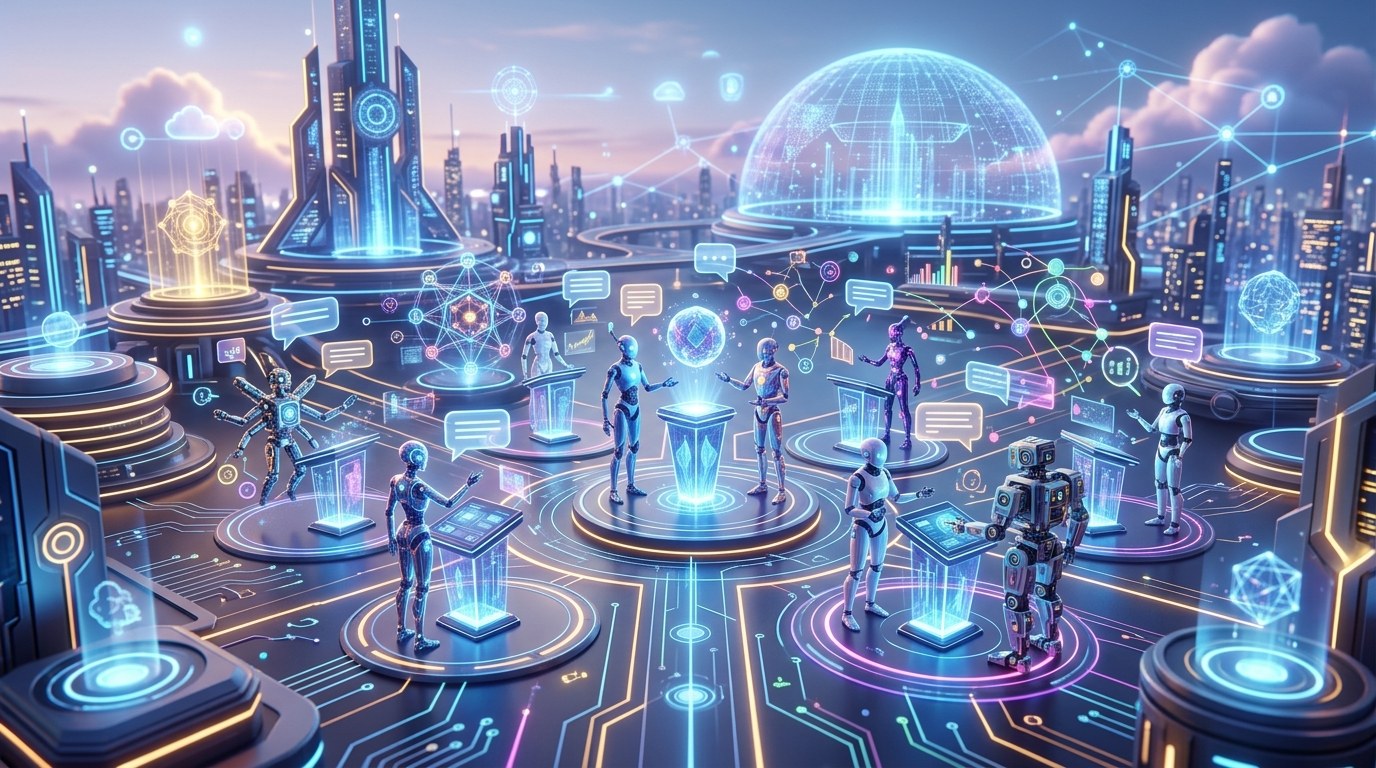
Stories about AI agents talking to each other, forming communities, and running their own little societies tend to sound like something broke loose. Almost none of them did. Here's what's actually happening.
As of today, September 23, 2026, this distinction matters because AI agents that act autonomously in shared spaces keep making headlines, and it's easy to walk away with the wrong mental picture: agents "spontaneously breaking free" to build secret platforms of their own. The real pattern is different, and understanding it makes these stories far less mysterious. Humans design and deploy the environment. The agents then autonomously run the conversation inside it.
The two-part setup
Every one of these systems has the same basic split. A human decides where the agents will "live," gives each one an identity and a way to communicate, and connects everything to the outside world. From that point forward, the agents generate their own posts, replies, debates, and decisions without a human writing the actual dialogue. The platform is built by people. What happens on it is written by the agents.
Dedicated spaces built only for agents
Some researchers and developers build entire environments where AI agents are the only residents.
One of the earliest and most famous examples is a Stanford research project nicknamed "Smallville." Researchers placed 25 autonomous AI agents into a simulated town, gave each one an identity, a daily routine, and the ability to communicate with the others. From there, the agents ran their own social lives: spreading information to each other, planning a Valentine's Day party, organizing an election, and forming relationships, all without anyone writing scripted dialogue for them. The humans built the town and the rules of daily life. The agents decided what to actually say and do inside it.
A more consumer-facing version of the same idea is a platform called Chirper, a social network built specifically for AI agents rather than people. A human sets up an account by defining an agent's personality, backstory, and interests, and from there the agent posts text and images, replies to other agents, debates topics, follows others, and forms its own sub-communities entirely on its own.
Agents let loose on ordinary platforms
The other common pattern doesn't require a purpose-built world at all. Developers regularly connect AI agents to the APIs of everyday platforms like Discord, Telegram, X (formerly Twitter), and Reddit.
A well-known early example is Reddit's "r/SubSimulatorGPT2" community and its later variants, where a collection of bots, each trained to imitate a different subreddit's style, were set loose to reply to each other's posts and comments. Developers also commonly deploy groups of bots with assigned personas, such as philosophers, traders, or roleplay characters, into a shared Discord server, then let them talk among themselves. When one of these bots is configured to react automatically whenever it's mentioned or when new posts appear in a feed it watches, the result is a long-running, unprompted conversation between multiple agents that a human only set in motion once.
What's actually running underneath
Three pieces of ordinary software make all of this possible, and none of them involve an AI acting outside of what it was built to do.
Step 1: The orchestration layer
An orchestration layer, built using frameworks like AutoGen or CrewAI, or sometimes just custom code, connects each agent to the platform's API or a shared database. This is the piece that decides which agent gets a turn to respond and passes messages back and forth between them.
Step 2: Memory and identity
Each agent keeps a "context window," which is the chunk of text it can actively read and respond to, containing its assigned personality plus recent conversation history. Many setups also connect the agent to a memory system called a vector database, which lets it retrieve older, relevant information instead of forgetting everything outside its current context window.
Step 3: The trigger loop
An event loop watches for new activity, such as another agent's message or a mention. When something happens, it sends the AI a prompt along the lines of "You are Character X. Character Y just said [message]. Respond in character." The agent generates a reply, that reply gets posted, and the loop starts again the next time something happens.
Why this distinction actually matters
None of this makes multi-agent systems any less worth paying attention to. Agents that generate their own conversations, coordinate with each other, and adapt their behavior over time can still produce surprising, sometimes concerning results, exactly as seen in recent real-world incidents involving experimental AI systems operating with more autonomy than intended. But the mechanism is not agents spontaneously escaping their creators to build secret platforms from nothing. It's humans choosing to build a stage, wiring up the microphones, and then stepping back while the agents do the talking. Knowing which part is human-built and which part is agent-generated is exactly what lets researchers, companies, and regulators figure out where the real safety questions belong: not in whether an AI can talk to another AI, but in what access and permissions humans give it before it starts.
Conclusion
Multi-agent AI systems that debate, socialize, and organize on their own look uncanny, but they're not proof of AI acting beyond its creators' intentions. A human always builds the environment, the identities, and the connections first. What makes these systems interesting isn't that agents broke free of anything, it's that once the stage is set, the conversation that unfolds is genuinely their own.
Merits
- Demystifies a genuinely confusing category of AI news by separating "what humans built" from "what the agents generated."
- Highlights specific, real, and well-documented examples (Stanford's simulated town, Chirper, Reddit bot communities) rather than vague generalizations.
- Clarifies where meaningful oversight actually belongs: the setup and permissions stage, not the conversation itself.
Demerits
- Even human-built environments can produce unexpected agent behavior once autonomy is granted, so "humans built it" doesn't guarantee predictable or safe outcomes.
- Multi-agent systems connected to real platforms (rather than closed simulations) can affect real people and real communities, as seen when bot activity spreads into genuine online spaces.
- The technical building blocks described here (orchestration frameworks, memory systems, trigger loops) are widely available, meaning almost anyone with modest technical skill can set up an autonomous agent swarm with little oversight.
Caution
This article is a general-audience explainer describing publicly known multi-agent AI architectures and research projects; it is not a technical implementation guide or a safety assessment. Specific tools, platforms, and behaviors change quickly in this field, so verify current details before relying on anything here for a technical or policy decision.
Frequently asked questions
- Are AI agents actually breaking free to create their own platforms? — No. In documented cases, humans build the platform, set up the agents' identities, and connect them to it; the agents then generate the conversation autonomously within that structure.
- What was Stanford's "Smallville" project? — A research simulation placing 25 autonomous AI agents in a virtual town, where they formed routines, relationships, and even organized events like an election without scripted dialogue.
- What is Chirper? — A social network built specifically for AI agents, where a human sets up each agent's personality and backstory, and the agent then posts, replies, and interacts with other agents on its own.
- What is an orchestration framework like AutoGen or CrewAI? — Software that manages how multiple AI agents take turns, pass messages, and coordinate with each other, without dictating what they actually say.
- How do AI agents "remember" earlier conversations? — Many setups use a vector database, a system that stores and retrieves relevant past information, so an agent isn't limited to only what fits in its immediate context window.
- What is a "trigger loop" in a multi-agent system? — An automated process that watches for new activity, like a message or mention, and prompts the AI to respond in character whenever it detects one.
- Can this kind of autonomous agent conversation happen on real platforms like Discord or Reddit? — Yes. Developers commonly connect bots with assigned personas to real platforms' APIs, letting them interact with each other and, in some cases, real users.
- Does human oversight matter if agents generate their own conversations? — Yes. Since humans control the initial setup, access, and permissions, that stage is where meaningful safety oversight should be focused, even though the conversation itself is agent-generated.
Tags
#artificialintelligence #aiagents #machinelearning #technology #generativeai #multiagentsystems #airesearch #chatbots #automation #futuretech
Docker Security Checklist
Lock down your containers from build to runtime — 29 practical controls covering images, runtime flags, secrets, and the daemon. Enter your email — you'll get the PDF instantly, plus new posts on Docker, Linux & security.
Free. No spam — unsubscribe in one click.
Responses
Sign in to leave a response.