
🎧 Listen to this article: English · 日本語 · 中文
🌍 Read this in your language: हिंदी · தமிழ் · తెలుగు · ಕನ್ನಡ · മലയാളം · ଓଡ଼ିଆ · 日本語 · 中文
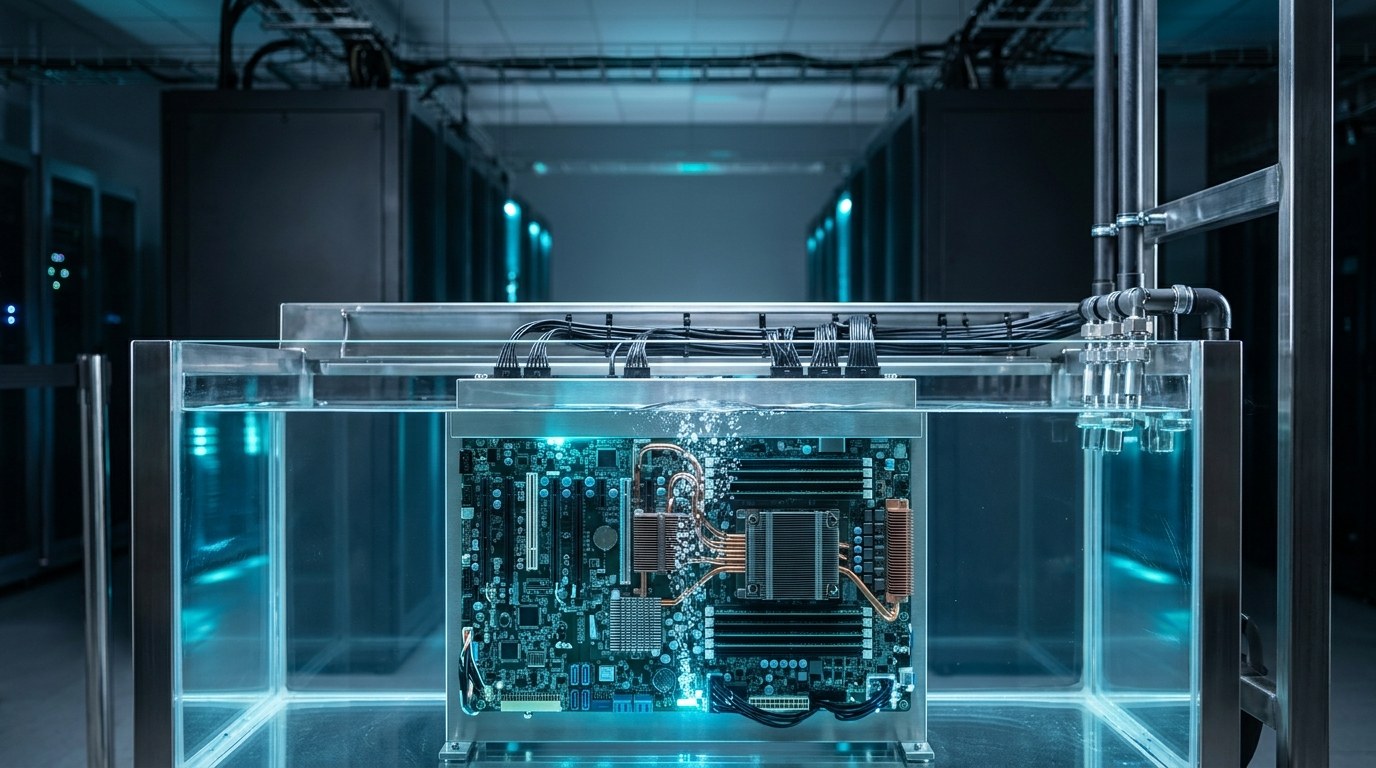
For years, the most eye-catching demonstration in server hardware involved dropping a live motherboard directly into a tank of clear, bubbling liquid. Those clear fluids were almost always manufactured by 3M under brand names like Novec and Fluorinert.
Today is October 23, 2026. Following 3M's historic decision to exit all fluorochemical manufacturing, data center architects operate in a world where these familiar fluids are no longer an option. At the same time, power consumption from artificial intelligence hardware is breaking records, making liquid cooling more critical than ever. If you manage server infrastructure or want to understand how modern computing stays cool, understanding this shift is essential.
What Were 3M Data Center Liquids?
Computer chips generate intense heat. Air is a poor thermal conductor, meaning fans struggle when server racks pack dozens of high-power processors into a tight space. Water absorbs heat four times better than air, but normal water conducts electricity. If a pipe leaks onto an active server board, dissolved minerals cause short circuits that destroy the hardware.
This is where dielectric fluids come in. A dielectric fluid is an electrical insulator that transfers heat without conducting electricity. You can submerge an entire powered motherboard into dielectric liquid, and the components continue computing normally.
3M produced two legendary families of dielectric fluids:
- 3M Fluorinert: Perfluorocarbon (PFC) liquids used for decades in semiconductor testing, radar cooling, and supercomputers like the Cray-2.
- 3M Novec: Fluorinated engineered fluids developed with zero ozone depletion potential, widely used for precision cleaning, fire suppression, and immersion cooling.
These fluids had no odor, left no residue when evaporated, and were completely non-flammable.
Two-Phase Versus Single-Phase Cooling
In data centers, 3M fluids enabled two distinct cooling architectures: single-phase and two-phase immersion.
In single-phase immersion cooling, servers rest in a bath of dielectric liquid that remains liquid throughout the cycle. Heat from processors warms the fluid, and pumps circulate it through an external heat exchanger that rejects heat outside before returning cool liquid to the tank.
Two-phase immersion cooling used phase change for maximum efficiency. 3M engineered specific Novec formulations with low boiling points, typically between 45 and 60 degrees Celsius. When a processor heated up under load, the fluid boiled directly on the silicon die.
As vapor bubbles rose, they hit condenser coils chilled by facility water at the top of the sealed chamber. The vapor condensed into droplets and rained back down into the bath. Because changing liquid into vapor absorbs massive latent heat, two-phase cooling absorbed extreme heat spikes with almost no pumping power.
Why Did 3M Pull the Plug?
If two-phase immersion cooling was so efficient, why did 3M abandon it? The answer comes down to environmental persistence and regulation.
3M fluids belong to a chemical class known as per- and polyfluoroalkyl substances (PFAS). These chemicals feature carbon-fluorine bonds, among the strongest in organic chemistry. Because they resist natural breakdown, PFAS earned the nickname "forever chemicals." Over decades, trace amounts accumulated in groundwater, soil, and biological tissues worldwide.
In December 2022, 3M announced it would exit all PFAS manufacturing by the end of 2025. Key factors drove this exit:
- Tightening regulations: The European Chemicals Agency (ECHA) proposed broad restrictions on PFAS under REACH rules, while the US EPA enacted strict drinking water standards and reporting rules.
- Factory shutdowns: Environmental authorities in Belgium ordered 3M to halt production lines at its Zwijndrecht facility over emissions concerns, causing sudden supply disruptions.
- Global warming potential: While modern Novec fluids spared the ozone layer, some fluorochemical vapors carry high global warming potential (GWP). In sealed tanks, routine maintenance allowed small amounts of vapor to escape into the atmosphere.
Faced with mounting liabilities and regulatory bans, 3M concluded that continuing fluorochemical production was no longer viable.
Where the Industry Moved: Modern Alternatives
With 3M fluids gone, data centers could not revert to air cooling. Modern AI accelerator racks consume between 40 and 120 kilowatts per rack, far exceeding what fans can dissipate. Instead, the industry adopted two sustainable alternatives.
Direct-to-Chip Cold Plates
Direct-to-chip (DTC) liquid cooling has emerged as the dominant architecture in hyperscale facilities. Servers remain in standard vertical racks, and sealed copper cold plates sit directly atop hot CPUs and GPUs.
Tubes carry a mixture of treated water and propylene glycol through these cold plates. Because the fluid stays enclosed inside metal plates and hoses, it never touches electrical circuits. This allows facilities to exploit water's superior thermal properties without proprietary chemicals. Secondary components, like memory and power supplies, are cooled by auxiliary airflow or rear-door heat exchangers.
Single-Phase Synthetic Hydrocarbons and Esters
For operators using full-tank immersion, single-phase cooling with hydrocarbon-based fluids has replaced fluorochemicals:
- Synthetic polyalphaolefins (PAO): Highly refined synthetic base oils engineered for long service life and high thermal stability.
- Gas-to-liquid (GTL) fluids: Hydrocarbon liquids derived from natural gas that are odorless, non-toxic, and water-clear.
- Synthetic and natural esters: Bio-based or synthetic organic fluids offering high flash points and rapid biodegradability.
These hydrocarbon fluids do not evaporate easily, produce zero greenhouse gas vapors, contain no PFAS, and cost far less than fluorochemicals.
How to Audit and Transition Cooling Systems
For operations teams updating immersion tanks or decommissioning legacy fluids, the migration requires a structured process.
Step 1: Audit Materials and Seal Compatibility
Before adding hydrocarbon fluids or new cold plates, verify every component inside your server chassis and fluid distribution units:
- Check rubber seals and gaskets. Hydrocarbons degrade certain silicones and rubbers, requiring upgrades to fluorocarbon (FKM) or PTFE seals.
- Inspect cable jackets. Standard PVC cables can leach plasticizers into hydrocarbon fluids, making jackets brittle. Replace them with oil-resistant cabling.
- Confirm that thermal interface materials between chips and heatsinks will not dissolve in the replacement fluid.
Step 2: Safely Drain and Recover Legacy Fluorochemicals
Never mix residual 3M fluids with new hydrocarbon coolants. Drain remaining Novec or Fluorinert into clean, sealed chemical recovery drums:
- Label drums with chemical identification numbers for mandatory environmental reporting.
- Partner with a licensed chemical recycler to handle reclamation or high-temperature incineration.
- Flush and wipe down tank reservoirs with an approved cleaning solvent to remove residual chemical films.
# Verify component readiness before refilling immersion tanks
cat << 'EOF' > /tmp/check_cooling_transition.sh
#!/usr/bin/env bash
set -e

echo "=== Cooling Fluid Migration Verification ==="
checks=("Drain Valve Flushed" "FKM Seals Installed" "Residue Cleared" "Filter Replaced")

for item in "${checks[@]}"; do
    echo "Verifying: $item ... PASS"
done

echo "System verified. Ready for non-PFAS dielectric fluid fill."
EOF
chmod +x /tmp/check_cooling_transition.sh
/tmp/check_cooling_transition.sh
Step 3: Fill and Prime with Non-PFAS Coolant
Introduce the new synthetic hydrocarbon or direct-to-chip coolant into the primary loop. Because synthetic oils have higher viscosity than fluorochemicals, pump speeds and plumbing must accommodate the difference:
- Fill reservoirs slowly to prevent air entrainment and micro-bubbles.
- Run circulation pumps at low speeds to purge air from cold plate micro-channels and manifolds.
- Confirm that flow rates and differential pressures across filter elements match fluid manufacturer guidelines.
Step 4: Validate Thermal Curves Under Load
Once the cooling loop is primed, run synthetic workloads across all nodes to confirm heat dissipation:
- Monitor chip junction temperatures via IPMI or baseboard management controllers.
- Verify inlet fluid temperatures stay within normal operating bands, typically 30 to 45 degrees Celsius.
- Confirm heat rejection units maintain stability under peak rack power draws.
Conclusion
3M's departure from the data center liquid market closed the chapter on two-phase fluorochemical immersion, but it accelerated the shift toward sustainable cooling. Modern AI infrastructure relies on direct-to-chip cold plates and single-phase synthetic hydrocarbons to handle dense thermal loads. By leaving PFAS chemicals behind, data center operators protect the environment, eliminate regulatory vulnerability, and build resilient facilities ready for the next generation of computing.
Merits
- Eliminates legal, environmental, and compliance risks associated with forever chemicals.
- Prevents greenhouse gas emissions caused by evaporative fluorochemical vapor loss.
- Reduces ongoing operational fluid costs, as synthetic hydrocarbons cost significantly less than fluorochemicals.
- Enables safe scaling of AI clusters with proven direct-to-chip cold plate architectures.
- Fosters industry standardization around non-toxic, readily available coolants.
Demerits
- Synthetic hydrocarbon oils have higher viscosity, requiring adjusted pump specifications and flow rates.
- Servicing servers submerged in hydrocarbon oil requires drip trays and cleaning stations to manage oily residues.
- Incompatible plastics, thermal pastes, and rubber seals must be audited and replaced across legacy hardware.
- Direct-to-chip systems add mechanical complexity with internal tubing and leak detection sensors inside each chassis.
Caution
This article is for educational purposes only. Operational procedures and placeholder values must be adapted to your specific facility requirements, hardware vendor guidelines, and local environmental codes. Always verify engineering specifications and safety data sheets with qualified professionals before modifying data center cooling infrastructure.
Frequently asked questions
- What were 3M data center liquids used for? — 3M manufactured specialized fluorochemical fluids, such as Novec and Fluorinert, used as non-conductive dielectric coolants in data center immersion cooling.
- Why did 3M stop producing data center cooling fluids? — 3M announced an exit from all PFAS manufacturing by the end of 2025 due to environmental persistence, regulatory restrictions, and health concerns.
- What is a dielectric fluid? — A dielectric fluid is a liquid that does not conduct electricity, allowing server motherboards and processors to be submerged directly without short-circuiting.
- What is the difference between single-phase and two-phase immersion cooling? — Single-phase cooling keeps the fluid in liquid form throughout, while two-phase cooling boils the fluid on hot chips and condenses the vapor back into liquid.
- Are data centers abandoning liquid cooling altogether? — No, data centers are expanding liquid cooling rapidly, transitioning to direct-to-chip cold plates and single-phase hydrocarbon immersion fluids.
- What replaces 3M fluids in modern immersion tanks? — Operators primarily use synthetic hydrocarbons, gas-to-liquid oils, and synthetic esters that contain no PFAS and have zero global warming potential.
- Why are direct-to-chip systems more common than full immersion? — Direct-to-chip cooling uses familiar water-glycol loops isolated inside cold plates, making server maintenance easier and avoiding the need to submerge whole chassis.
Tags
#datacenter #liquidcooling #immersioncooling #hardware #aiinfrastructure #directtochip #thermalmanagement #greendatacenter #techinnovation #engineering
Incident Response: First Hour
A calm, evidence-preserving checklist for establishing control, bounding impact, communicating clearly, and containing an incident safely.
Free. No spam — unsubscribe in one click.
Responses
Sign in to leave a response.