
🎧 Listen to this article: English
🌍 Read this in your language: हिंदी · தமிழ் · తెలుగు · ಕನ್ನಡ · മലയാളം · ଓଡ଼ିଆ · 日本語 · 中文
When consumers walk down grocery aisles, few consider the digital hardware regulating milk, meat, and fresh produce. Over the past several weeks, those unnoticed commercial refrigeration systems became the front line of an international cybersecurity crisis.
On November 23, 2026, British supermarkets and food suppliers are carrying out a nationwide effort to protect their cold chain. The operation follows widespread cyberattacks on retail refrigeration across continental Europe that forced stores to discard vast quantities of spoiled food. In response, UK retailers were asked to unplug public internet connections to their cooling controllers and log temperatures by hand while technicians patched critical security flaws. The joint initiative united supermarket cybersecurity teams, refrigeration contractors, the National Cyber Security Centre, and food safety regulators to keep chillers running safely.
The Hidden Infrastructure of Commercial Cold Chains
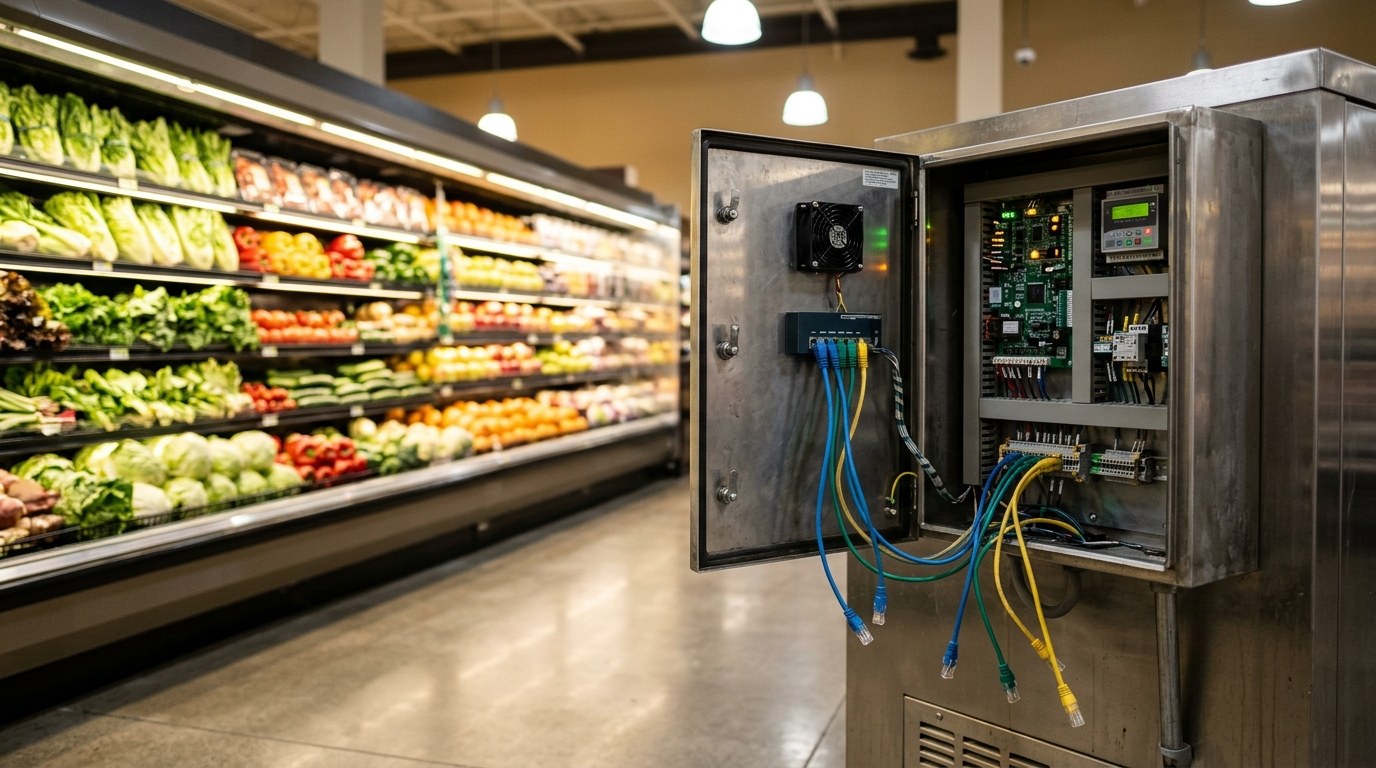
Modern supermarket refrigeration is far more complex than domestic appliances. A single commercial refrigeration controller manages multiple display cases, walk-in freezers, and cold rooms. These controllers adjust compressor speeds, balance refrigerant levels, and schedule regular defrost cycles.
To save time and money, retail chains and independent shops connect their controllers to the internet. Remote connectivity enables maintenance contractors to diagnose faults, tweak setpoints, and monitor energy efficiency without dispatching an engineer to the site. Many systems rely on cellular modems or direct port-forwarding on local broadband routers.
When an unauthorized intruder gains access to an internet-exposed controller, the consequences can be severe. An attacker can turn off cooling loops, trigger continuous defrost heaters, or silence automated warning systems. Because identical hardware is frequently deployed across hundreds of branch stores, a single vulnerability can endanger an entire retailer's inventory overnight.
The European Sabotage Wave: France to the Nordic Region
The vulnerability of retail cooling became undeniable during a coordinated assault in France overnight on October 11 and 12. Attackers remotely altered refrigeration parameters across more than 700 French retail locations. The sabotage forced cooling units into prolonged heating cycles, igniting localized fires and spoiling food valued in the tens of millions of euros. The French foreign ministry described the operation as the first cyber campaign conducted on French territory solely for physical sabotage, attributing the incident to Shahid Kaveh, an offensive cyber unit linked to Iran's Islamic Revolutionary Guard Corps.
Tehran denied involvement, and the perpetrators behind subsequent incidents across Europe have not been formally identified. However, copycat attacks quickly spread. On November 2, retailers in Belgium, Estonia, Finland, Ireland, Luxembourg, the Netherlands, and Sweden reported widespread cooling anomalies.
The timing of these intrusions maximized financial damage. By executing commands late at night, attackers left chillers warming for hours before morning staff arrived. Store managers faced difficult decisions regarding which chilled items had exceeded legal safety limits and had to be discarded.
How British Engineers Uncovered the UK Exposure
British supermarkets largely avoided the initial French wave because UK retail facilities typically deploy different hardware models from those targeted across the Channel. However, that separation proved temporary.
Neil McCourt, a specialist at refrigeration consultancy Omega Solutions, suspected that alternative hardware might suffer from similar vulnerabilities. He teamed up with Andrew Tierney and researchers at cybersecurity consultancy Pen Test Partners to examine commercial controllers manufactured by Resource Data Management, a Scottish vendor known as RDM.
Their laboratory testing revealed multiple critical flaws in RDM equipment. The researchers discovered that attackers could bypass authentication and take full control of connected chillers remotely. RDM chief executive Ged Evans confirmed that researchers dismantled controller hardware during their evaluation and stated that the company had released initial patches and customer advisories.
British food suppliers had already experienced early signs of interference. Three UK meat suppliers reported malicious tampering targeting Copeland XWEB supervisory controllers, an alternative controller family. In one incident, an attacker reconfigured cooling systems to initiate a defrost cycle every sixty minutes. Fortunately, the units were empty at the time, preventing inventory loss.
A separate incident at British organic wholesaler Langridge Organic exposed another tactic. Intruders infiltrated monitoring systems and disabled automated warning alerts. The system appeared quiet and normal while temperatures drifted upward, demonstrating why digital dashboards alone cannot be trusted during an active incident.
An Emergency Response Protocol for Cold Chain Operators
Securing thousands of distributed cooling installations requires a clear, step-by-step procedure combining digital isolation with manual oversight.
Step 1: Identify and Isolate Exposed Controller Interfaces
Technical teams must first map every internet-facing controller across retail branches and warehouses. Using network asset inventories and scanning tools, engineers locate any controller accessible over the public internet. Technicians immediately sever direct connections by disconnecting external Ethernet cables or shutting down cellular ports, leaving local cooling operations intact.
Step 2: Implement Physical and Manual Temperature Logging
With remote monitoring severed, on-site personnel must conduct manual temperature inspections. Staff use calibrated handheld digital thermometers to verify ambient air and internal product temperatures. Under guidelines from the UK Food Standards Agency, cold food must remain below the 8 degrees Celsius legal limit applicable in England, Wales, and Northern Ireland. The agency recommends setting refrigeration units to 5 degrees Celsius or lower to account for daily operational swings. Manual log sheets provide an immediate, tamper-proof record of food safety.
Step 3: Apply Vendor Firmware and Isolate Behind Virtual Private Networks
Once emergency isolation is achieved, qualified technicians apply the latest vendor firmware updates, such as advisory RDM-SA-2026-001 issued by RDM. Where remote monitoring remains necessary for maintenance, technicians place the equipment behind a secure virtual private network. Controllers using cellular connections must route traffic through private mobile access points rather than raw public internet addresses.
Step 4: Re-evaluate and Test Automated Alarm Pipelines
Finally, engineering teams must independently verify that alerting mechanisms function properly. Technicians simulate sensor alarms to confirm that text and email warnings reach on-call personnel. Administrators enforce multi-factor authentication across all engineering management portals and ensure system silence cannot be mistaken for normal operation.
The Challenge of the Long Tail: Independent Retailers
While major supermarket chains possess dedicated cybersecurity teams capable of auditing their entire estate within hours, the broader food sector faces a steeper challenge.
Thousands of independent butchers, convenience stores, and cold-storage warehouses rely on third-party HVAC contractors who installed their equipment years ago. In many cases, neither the shop owner nor the contractor realizes that an RDM or Copeland controller is directly accessible from the public internet.
This visibility gap prompted Pen Test Partners to disclose their findings publicly on November 20 after weeks of private coordination with the National Cyber Security Centre, the British Retail Consortium, and government departments. Raising awareness remains the only practical way to encourage independent operators to audit equipment before adversaries exploit unpatched systems.
Conclusion
The cyberattacks targeting European refrigeration reveal how vulnerable daily essentials can be to operational technology threats. British supermarkets demonstrated that coordinated defense and basic network isolation can safeguard critical infrastructure under pressure. Securing the entire food supply chain will require ongoing vigilance, firmware updates, and regular verification from every grocer, farmer, and refrigeration technician across the country.
Merits
- Demonstrates rapid collaboration between private engineers, retailers, and government cyber agencies.
- Prevents catastrophic inventory spoilage through timely network disconnection and manual temperature checks.
- Eliminates direct internet exposure for thousands of critical industrial controllers.
- Prompts hardware manufacturers to release rapid firmware patches and security advisories.
- Reinforces food safety compliance by validating physical temperatures against regulatory standards.
Demerits
- Demands intensive manual labor from retail staff to measure and record temperatures by hand.
- Temporarily deprives refrigeration engineers of remote diagnostic and energy management capabilities.
- Leaves thousands of independent grocers and small suppliers vulnerable due to contractor dependencies.
- Exposes persistent architectural weaknesses in legacy industrial control hardware across commercial facilities.
- Risks customer panic or supply chain friction if cooling failures require emergency product disposals.
Caution
This article is provided for educational and informational purposes based on public incident reports, manufacturer advisories, and government guidelines as of late November 2026. Device configuration steps, network settings, and food storage thresholds must be verified against current manufacturer documentation and local regulatory standards before implementation.
Frequently asked questions
- Why were UK supermarkets disconnecting their refrigeration systems? — Retailers unplugged internet-facing controllers to prevent remote cyberattacks from disabling chillers or altering temperature settings.
- Were any British supermarkets breached using the RDM vulnerability? — As of late November 2026, researchers reported no confirmed intrusions against UK supermarkets using the newly disclosed RDM vulnerability.
- What happened during the refrigeration attacks in France? — Saboteurs remotely disrupted cooling across more than 700 retail sites, sparking fires and causing tens of millions of euros in spoiled food.
- Who was blamed for the attacks on French supermarkets? — The French government attributed the October attack to Shahid Kaveh, an offensive cyber unit linked to Iran's Islamic Revolutionary Guard Corps.
- Did any UK food businesses suffer disruption? — Yes, three meat suppliers experienced automated hourly defrost tampering via Copeland controllers, and an organic wholesaler had its temperature alarms disabled.
- What is the legal temperature limit for chilled food in the UK? — Chilled food in England, Wales, and Northern Ireland must remain at or below 8 degrees Celsius, with the Food Standards Agency recommending fridges be kept at 5 degrees Celsius or below.
- How can commercial refrigeration controllers be secured safely? — Operators should remove controllers from the public internet, deploy firmware updates, and require virtual private networks for remote maintenance.
Tags
#Cybersecurity #Supermarkets #CriticalInfrastructure #IoT #FoodSafety #ColdChain #IndustrialSecurity #RDM #PenTestPartners #InfoSec
Prompt-Injection Defense Checklist
The controls that actually reduce the blast radius when your app feeds untrusted text to an LLM. Enter your email — you'll get the PDF instantly, plus new posts on AI, security & Linux.
Free. No spam — unsubscribe in one click.
Responses
Sign in to leave a response.