
🎧 Listen to this article: हिंदी · English · தமிழ் · తెలుగు · ಕನ್ನಡ · മലയാളം · ଓଡ଼ିଆ · 日本語 · 中文
🌍 Read this in your language: हिंदी · தமிழ் · తెలుగు · ಕನ್ನಡ · മലയാളം · ଓଡ଼ିଆ · 日本語 · 中文
A medicine used to take more than a decade to go from a laboratory idea to a pharmacy shelf. Today some of the slowest steps on that road are measured in months, and a few in hours.
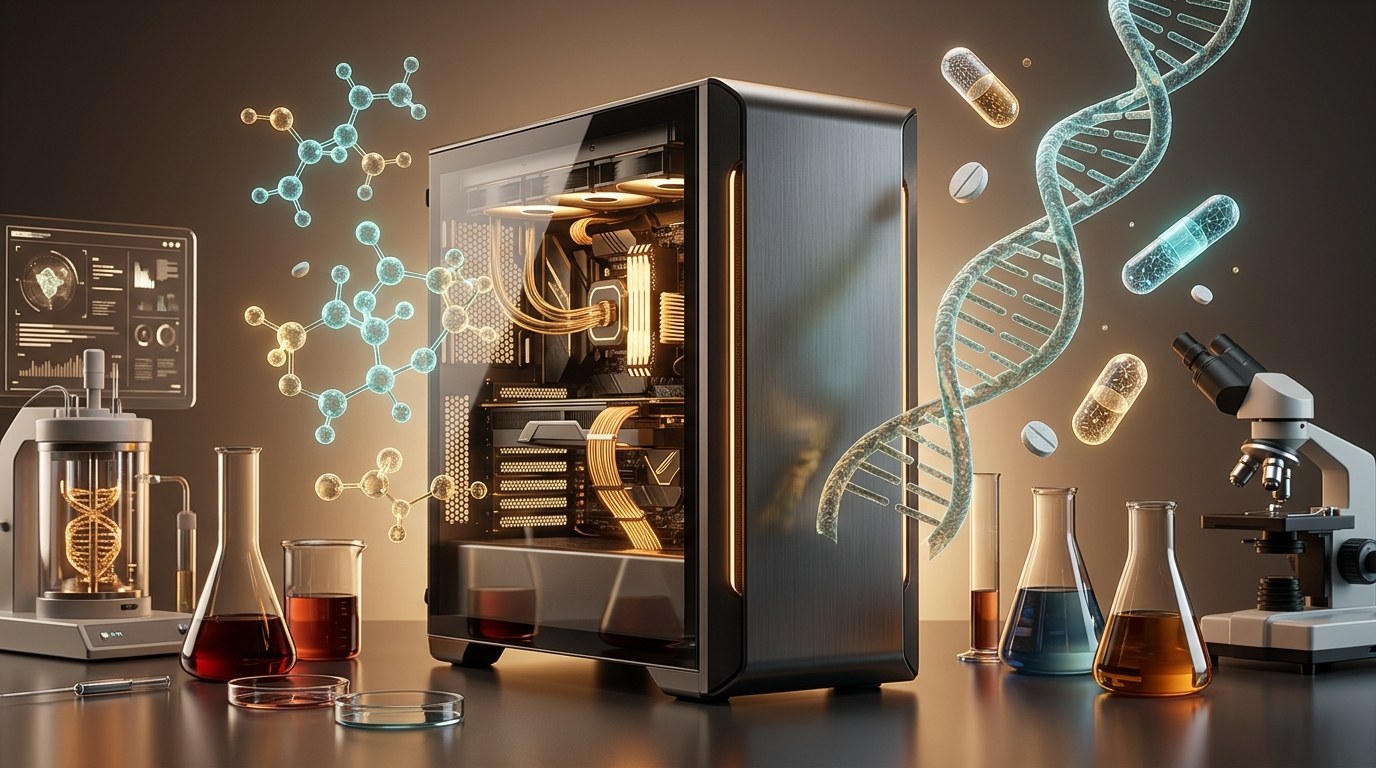
It is October 12, 2026, and this matters right now for a simple reason. The two technologies behind the change, supercomputing and artificial intelligence, have both crossed a threshold in the last few years. Computers big enough to simulate molecules atom by atom are no longer rare, and AI models that learn from biology have gone from research curiosities to tools that won a Nobel Prize. Governments, hospitals and drug companies are all betting on this combination, and the results are starting to reach ordinary patients. This post walks through the whole picture in plain language, keeping three things separate: what is available today, what is in clinical trials, and what is still early research.
What a supercomputer is, and why AI needs one
A supercomputer is not one giant chip. It is thousands of ordinary computers wired together so tightly that they work on a single problem as one machine. The fastest can perform more than a billion billion calculations every second, a scale called exascale, and the first such machine was switched on only a few years ago.
Why does medicine need that? Because biology is enormous. A single cell holds billions of molecules, each jostling, folding, binding and breaking apart. Simulating even a tiny piece of that for a fraction of a second means tracking an astonishing number of interactions. A desktop would take years; a supercomputer takes days.
Artificial intelligence is the second piece: software that learns patterns from large amounts of data instead of following hand-written rules. Training a model on millions of protein shapes, scans or patient records is itself a huge computing job, which is why AI and supercomputing grew up together. The supercomputer is the muscle; the AI is the judgement about where to point it. Together they let research that once meant decades of trial and error in a wet lab be narrowed, in simulation, to a short list of candidates worth testing for real.
Predicting the shape of life: protein structures
Proteins are the working parts of every living thing. They carry oxygen, digest food, send signals and build tissue. What a protein does depends almost entirely on its three-dimensional shape, decided by a long chain of building blocks called amino acids folding up on itself. For half a century, finding that shape meant growing crystals and bombarding them with X-rays, which could take years for a single molecule and sometimes failed outright.
AI changed that. Models trained on every known protein structure can predict the folded shape of a new protein from its sequence alone, in minutes, with accuracy that often matches the laboratory. The work was recognised in 2024 when the creators of the AlphaFold system shared the Nobel Prize in Chemistry with a pioneer of computational protein design. That prize is a useful marker: this is settled science, not hype.
Why it matters: many diseases involve a misbehaving protein. If you know its exact shape, you can design a small molecule that fits into it like a key into a lock and switches it off. Some disease proteins were long called "undruggable" because nobody could see where a drug might attach. With accurate structures, researchers can search those surfaces for hidden pockets and design targeted therapies. It is one of the biggest reasons the early stages of drug discovery are getting faster.
Old drugs, new jobs: repurposing
Developing a brand-new medicine is risky and slow. A cheaper route is to find a new use for a drug that already exists, because its safety in people is already understood. AI suits this hunt well: a model can compare thousands of approved medicines against thousands of disease targets and flag unexpected matches no human would think to test, which then go to the lab for confirmation. The approach was used widely during the COVID-19 pandemic and has stayed in the toolbox. It will not replace new drug development, but it can deliver treatments years sooner for conditions that have none.
Simulating biology to make trials safer
Before a medicine reaches people it must be tested for toxicity, meaning harm to organs such as the liver, heart or kidneys. Traditionally that means animal studies and then small, cautious human trials, and failures here are common and costly. Supercomputers now let researchers simulate how a candidate molecule interacts with complex biological systems before any animal or person is exposed to it, predicting, for instance, whether it is likely to bind to a heart protein it should leave alone. Candidates with warning signs are dropped early. No regulator accepts a simulation in place of real testing, but it cuts the number of risky compounds that reach the first human phase.
Digital twins: a virtual copy of you
A digital twin is a computer model of a real object, kept updated with live data from that object. Engineers have used twins of aircraft engines for years. Medicine is now trying to build them for people: combine your scans, genes, blood results and wearable data into a simulation of your body, then test medicines or doses on the simulation before giving anything to you. If the twin shows a blood-pressure drug would push your heart rate too low, the doctor chooses another.
Be clear about where this stands. Twins of single organs, especially the heart, are used in research hospitals and some clinical studies today. A faithful twin of a whole human body, accurate enough to stand in for the real person, is a future goal, not an available service.
Synthetic biology and artificial organs
Synthetic biology is the engineering of living cells to do new things, such as making a medicine or growing into a particular tissue. With AI designing the instructions, it raises the possibility of building replacement organs to order. Today researchers can grow small tissue samples, and bioprinting (building tissue layer by layer from living cells) is an active field. A full working organ ready for transplant remains early research; lab-grown skin and cartilage are far closer than a lab-grown kidney.
Steadier hands: AI-assisted robotic surgery
Robotic surgery is already common: a surgeon at a console controls instruments that move with less tremor than a human hand. What is new is the AI layer on top. With enough computing behind it, a surgical system can process live imaging during an operation, highlight blood vessels or tumour margins hidden deep in tissue, and warn before an instrument strays. Systems that help identify tissue and reduce bleeding are in use in some hospitals now. Fully autonomous surgery is not; the surgeon still makes every decision.
Reading the records: better diagnosis and treatment plans
A doctor cannot read every medical journal or remember every similar case. AI can. Models trained on large bodies of medical literature and anonymised patient histories can summarise what is known about a condition, suggest tests that may have been missed and draft a treatment plan for the doctor to review. Hospitals use such tools now, mostly for notes and risk flags. The key phrase is "for the doctor to review": these systems can be confidently wrong, and the data they learned from may not represent every population fairly.
Cancer: treatment tailored to the tumour
Cancer is not one disease. Two patients with "the same" cancer may have tumours driven by different genetic mistakes, and a drug that works on one may do nothing for the other. Sequencing a tumour's DNA is now routine in many cancer centres, and AI helps interpret the result, matching the mutations found against known treatments and trials to produce a tailored protocol with the best chance of recovery and the fewest side effects, because the drugs target the tumour's actual weaknesses rather than every fast-growing cell. This is available today, though access varies hugely.
Preventive genomics: stopping disease before it starts
Your genome is your full set of DNA, and reading it is now cheap enough that preventive genomics, using genetic information to prevent disease rather than treat it, is a realistic goal. AI models combine thousands of small genetic variations into a risk estimate for conditions such as heart disease or certain cancers, so a person with a high score can be offered earlier screening or lifestyle changes years before any symptom. Specialist clinics offer some of this already; population-wide use is still being studied. The scores also work less well for groups under-represented in the databases they were built from, a known bias and an active area of work.
Alzheimer's: seeing the disease earlier
Alzheimer's damages the brain for years before memory problems appear. AI models trained on large collections of brain scans can detect subtle changes well before a radiologist would call them abnormal, and research systems can estimate how quickly a patient's disease is likely to progress, which helps families plan and helps doctors decide who may benefit from newer treatments. These tools are in clinical studies and limited use, and they need careful validation before anyone makes life-changing decisions on the strength of a scan.
Ageing and longevity: the far frontier
This part attracts the most excitement and the most exaggeration, so let me be precise.
Senescence and rejuvenation
As we age, some cells stop dividing but refuse to die. They linger, release inflammatory signals and damage their neighbours. This state is called senescence, and the build-up of senescent cells is linked to many diseases of old age. AI is being used to map the cellular pathways (the chains of chemical signals inside a cell) that push cells into senescence, and to search chemical libraries for compounds that might clear or rejuvenate them. The hope is to extend healthspan, the years lived in good health, and perhaps lifespan. A few compounds are in small trials for specific conditions. Nothing is approved for "anti-ageing" in healthy people, and anyone selling such a product today is selling hope, not evidence.
Cellular reprogramming
Cellular reprogramming means resetting an old cell to a younger state by switching on a handful of genes normally active only in early development. It works in cells in a dish and, in limited ways, in laboratory animals. Whether it can be done safely in a whole human, without triggering uncontrolled growth, is unknown. This is early research.
Nanomedicine
Nanomedicine uses particles far smaller than a cell to carry drugs or perform tasks inside the body. Some nanoparticle drug carriers are already in use. The dramatic vision, AI-designed microscopic robots travelling the bloodstream to repair damaged cells, is a future possibility. The designs exist in simulations and a few lab prototypes; machines that can navigate a living body and fix things do not exist yet.
Weight, metabolism and obesity
Obesity is one of the largest health problems of our time, and far more complicated than "eat less". AI is being applied from several directions.
- Personal plans. By analysing a person's genetic profile, metabolism, sleep and activity, a model can build a diet and exercise plan matched to how that body responds to food. Several services offer this now, with varying evidence behind them.
- New drugs. Machine learning is helping discover and refine medicines that reduce body fat. The recent wave of injectable weight-loss drugs, originally developed for diabetes, showed the demand, and AI-assisted discovery is hunting for the next generation.
- Molecular pathways. Researchers are targeting the signalling that controls how the body stores and burns fat, including metabolic boosters and genetic approaches to help the body burn more energy. The genetic approaches are early research, not treatments.
- Brown fat. Most body fat is white fat, which stores energy. Brown fat burns calories to make heat. Finding safe ways to activate it is an active research area, and AI is helping screen compounds that might. Laboratory-stage work.
Ten more frontiers worth knowing about
- CRISPR gene editing. CRISPR lets scientists cut and edit DNA at a chosen point. The first CRISPR-based treatment, for sickle cell disease, is approved in several countries. Editing embryos to free future generations from inherited disease is imaginable but ethically contested and prohibited in most places.
- Microbiome analysis. The microbiome is the community of trillions of bacteria in your gut. AI is linking patterns in it to immunity, digestion and mood, aiming to strengthen immunity through diet or targeted probiotics. Early but promising.
- Smart wearables. Watches and rings track heart rhythm, oxygen and sleep; with AI they can flag irregular heartbeats and other warning signs continuously. Available today; the challenge is false alarms.
- Personalised nutrition. AI diet advice based on your blood-sugar response, microbiome and genes is on the market. A useful guide, not a prescription.
- Mental health detection. Models that analyse speech, typing rhythm or sleep to spot early signs of depression or anxiety are in research and some apps. Privacy is a serious concern here.
- Newborn genetic screening. Sequencing a newborn's genome to catch treatable conditions in the first days of life is being piloted, with AI helping interpret results.
- Organ chips and mini-organs. Small devices lined with living human cells, and tiny lab-grown organoids, let researchers test drugs on human tissue without a patient. Multi-organ chips that link several together are starting to be accepted by regulators as supporting evidence.
- AI medical imaging. AI that reads X-rays, CT and MRI scans to spot fractures, bleeds and tumours is approved and in daily use in many hospitals, usually alongside a radiologist.
- Smart drug delivery. AI-designed carriers that release a medicine only at the target site are in development. Some nanoparticle carriers are in use; the fully "smart" versions are still being tested.
- Brain-computer interfaces. A brain-computer interface, or BCI, reads electrical signals from the brain and turns them into commands for a computer or prosthetic. Human trials have begun for people with paralysis, letting some control a cursor by thought. Using BCIs to rehabilitate coma patients is a research hope, not an established treatment.
Where things stand: a quick map
| Technology | Available today | In trials or pilots | Early research or future |
|---|---|---|---|
| AI protein structure prediction | Yes | ||
| AI-assisted medical imaging | Yes | ||
| Tumour sequencing and personalised cancer plans | Yes (uneven access) | ||
| Robotic surgery with AI guidance | Yes (assistive only) | ||
| Wearable monitoring with AI alerts | Yes | ||
| CRISPR therapy for specific diseases | Yes (very few) | Many more | Germline editing |
| Preventive genetic risk scores | Specialist clinics | Population studies | |
| Early Alzheimer's detection from scans | Limited | Yes | |
| Digital twin of an organ | Research hospitals | Yes | Whole body |
| Senolytic and rejuvenation compounds | Small trials | Healthy-person use | |
| Cellular reprogramming in humans | Yes | ||
| Nanorobots repairing cells | Yes | ||
| Lab-grown transplantable organs | Yes | ||
| Brain-computer interfaces | Yes (paralysis) | Coma rehabilitation |
The gap between the lab and your doctor
A result in a simulation is the start of the journey, not the end. Between it and a treatment you can receive lie animal studies, three phases of human trials, regulatory review and the business of manufacturing and paying for the medicine. Most candidates fail somewhere along that road. AI shortens the early steps and improves the odds, but it cannot skip the later ones, and regulators are still working out how to evaluate medicines designed by models they cannot fully inspect. Health data is also the most sensitive information most of us have, models trained mostly on one population can be less accurate for others, and the places that can afford exascale computing are not evenly spread around the world. None of this is a reason to stop; all of it is a reason to pay attention.
How to benefit from these advances today, safely
You do not need to wait for nanorobots. Here is a practical, low-risk way to use what is real now.
Step 1: Keep up with regular check-ups
Almost everything in this post works better the earlier a problem is found. The best AI scan reader in the world is useless if you never get the scan. Keep routine appointments and do the screening your doctor recommends for your age and family history.
Step 2: Ask about genetic testing where it makes sense
If several close relatives have had the same cancer, heart condition or inherited disease, ask your doctor whether genetic counselling and testing are appropriate. Go through a clinician, not a mail-order kit, so the result is interpreted properly.
Step 3: Use wearables as a prompt, not a diagnosis
A watch that flags an irregular heartbeat is a reason to see a doctor, not to panic or self-treat. A watch that says you are fine is not a clean bill of health either. Treat it as a sensible friend who sometimes worries too much.
Step 4: Guard your health data
Before handing your genome, scans or daily heart rate to an app, read who owns the data, whether it can be sold and whether you can delete it. Prefer services that store data in your own country under clear health-privacy rules. Genetic data, once leaked, cannot be changed like a password.
Step 5: Be sceptical of anything sold as anti-ageing
If a product claims to reverse ageing, clear senescent cells or reprogram your cells, and you can buy it online without a prescription, the claim is ahead of the evidence. The genuine research is in controlled trials, not on supplement shelves. Ask a qualified doctor before taking anything of the kind.
Step 6: Bring the AI to your appointment, with the doctor in charge
It is fine to use a reputable tool to prepare questions or understand a diagnosis. Bring what you found to your doctor and let them weigh it. The best results in this whole field come from a trained clinician and a well-built model working together.
Conclusion
Supercomputing gives medicine the power to simulate biology at a scale that was impossible a decade ago, and artificial intelligence gives it the judgement to decide what is worth simulating. Together they have already changed how proteins are studied, how cancers are treated and how scans are read. The more dramatic promises, whole-body digital twins, rejuvenated cells, printed organs, nanorobots, are real research programmes but not yet real treatments. The sensible position is excitement about the direction, patience about the timeline, and a qualified doctor as your guide for anything that touches your own body.
Merits
- Shortens early stages of drug discovery, in some cases from years to months, so promising treatments can reach trials sooner.
- Opens up disease targets that were previously considered undruggable.
- Finds new uses for existing, already-safe medicines at low cost.
- Reduces the number of toxic candidates that reach human trials.
- Makes cancer treatment more precise, with better outcomes and fewer side effects.
- Catches diseases such as Alzheimer's and some cancers earlier, when they are more treatable.
- Makes medical imaging faster and more consistent, easing the load on scarce specialists.
- Offers a credible scientific route into ageing, which was long treated as untouchable.
Demerits
- The most advanced tools are expensive, so access is uneven between countries and between hospitals.
- Health data privacy is at risk; genetic data in particular cannot be changed if it leaks.
- Models trained on unrepresentative data can be less accurate for women, minorities and under-studied regions.
- Over-hype is rampant, and the gap between a lab result and an approved treatment is routinely glossed over.
- Regulation lags behind the technology, especially for AI-designed drugs and devices.
- Over-reliance on AI suggestions can erode clinical judgement if doctors stop checking.
- Wearables and screening can produce false alarms, anxiety and unnecessary tests.
- The longevity field attracts unproven products that trade on genuine research for marketing.
Caution
This article is educational and is not medical advice. It describes a fast-moving field in plain language, and many of the technologies mentioned, including whole-body digital twins, cellular reprogramming, nanorobots, lab-grown organs and most anti-ageing compounds, are still at the research stage and are not available as treatments. Details change quickly, and I may have simplified or missed something. Please consult qualified doctors about your own health, and verify any claim, especially one attached to a product for sale, before relying on it.
Frequently asked questions
- What is a supercomputer and why does medicine need one? — A supercomputer is thousands of computers linked to work as one machine. Medicine needs that power to simulate molecules and cells, which involve far too many interactions for an ordinary computer.
- How does AI predict protein structures? — AI models learn from every known protein shape and predict how a new chain of amino acids will fold. The creators of the AlphaFold system shared the 2024 Nobel Prize in Chemistry for this work.
- Can AI really speed up drug discovery? — Yes, for the early stages such as finding and screening candidate molecules. Human trials and regulatory approval still take years and cannot be skipped.
- What is a digital twin in healthcare? — A computer model of a patient, updated with their real data, used to test treatments in simulation. Organ-level twins exist in research; whole-body twins are a future goal.
- Is AI anti-ageing treatment available today? — No. AI is helping find compounds that target cellular ageing, and a few are in small trials, but nothing is approved for extending lifespan in healthy people.
- Can AI help with weight loss? — AI can personalise diet and exercise plans and is helping discover new weight-loss drugs. Genetic and brown-fat approaches are still early research.
- What is CRISPR and is it used in patients? — CRISPR is a tool for editing DNA at a chosen point. A CRISPR therapy for sickle cell disease is approved; editing embryos is prohibited in most countries.
- Should I trust an AI health app or wearable? — Use them as prompts to see a doctor, not as diagnoses. Check how the app handles your data before sharing anything sensitive.
Tags
#Supercomputing #ArtificialIntelligence #Healthcare #DrugDiscovery #Longevity #Genomics #PrecisionMedicine #DigitalTwin #CRISPR #MedicalAI
Incident Response: First Hour
A calm, evidence-preserving checklist for establishing control, bounding impact, communicating clearly, and containing an incident safely.
Free. No spam — unsubscribe in one click.
Responses
Sign in to leave a response.