
🎧 Listen to this article: English
🌍 Read this in your language: हिंदी · தமிழ் · తెలుగు · ಕನ್ನಡ · മലയാളം · ଓଡ଼ିଆ · 日本語 · 中文
Grok Bot is changing the way we think about artificial intelligence (AI) in the workplace. As of today, September 14, 2026, the Grok Bot Galaxy event is kicking off a 72-hour demonstration. This event will showcase how Grok Bot can handle end-to-end workflows across various fields like business, engineering, and marketing. This topic is especially relevant now as we explore the potential of AI to take on more responsibilities.
From Chatbots to AI Agents
Most people are familiar with basic AI interactions. You might ask a chatbot a question, and it provides an answer. For example, you could ask it to explain a technical concept or help debug a piece of code. This approach is useful, but it’s also quite limited. You ask, it responds, and then you handle the rest.
With Grok Bot, the interaction changes significantly. Instead of just responding to prompts, Grok Bot can take on a more active role. You set a goal for it, and it plans and executes tasks on its own. This means that instead of merely answering questions, Grok Bot can manage entire workflows from start to finish.
What Can Grok Bot Do?
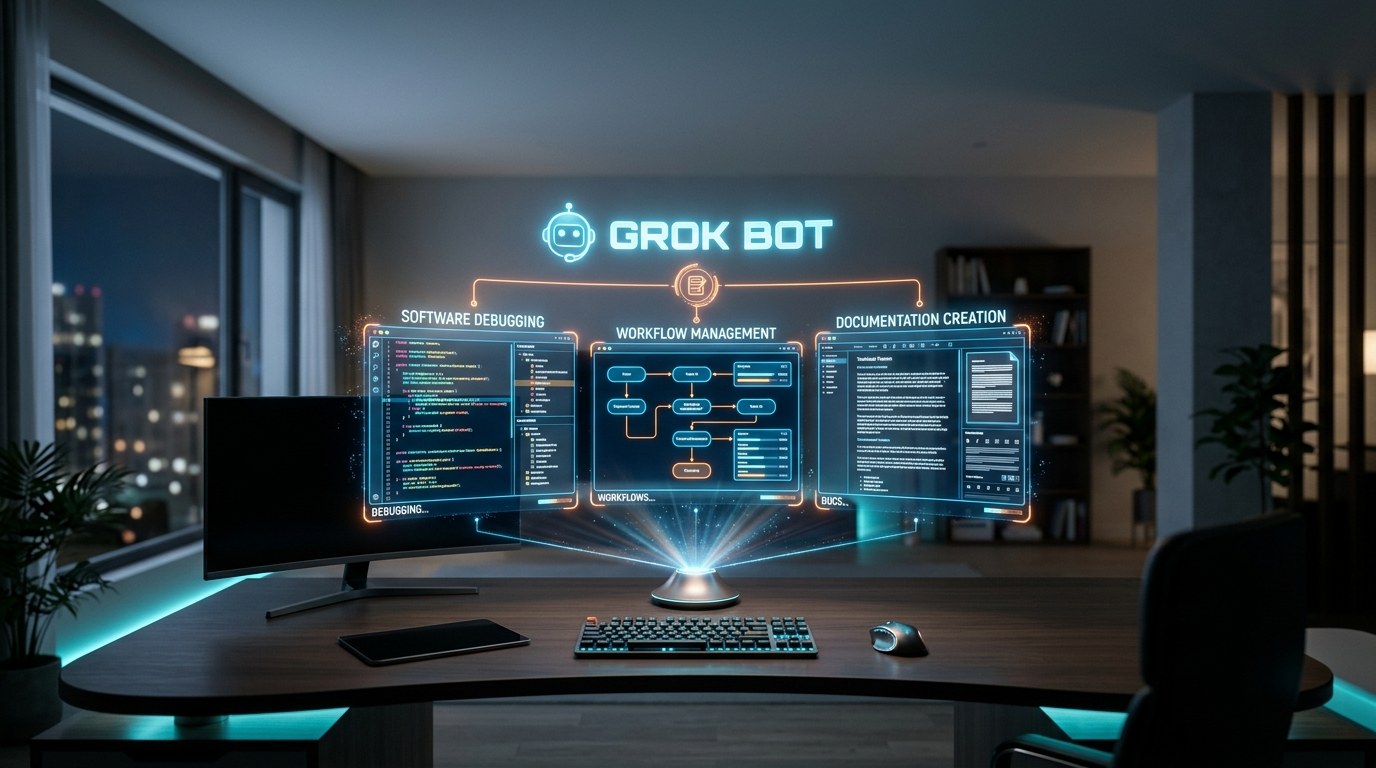
Imagine Grok Bot as a new member of your software engineering team. If there’s a bug to fix, instead of asking it how to reproduce the bug, you could assign it a task. For instance, you might say:
"Reproduce this bug, collect the relevant logs, document the steps, and create a Jira ticket."
In this scenario, Grok Bot could:
- Open the application.
- Follow the necessary steps to reproduce the issue.
- Collect logs and relevant information.
- Document the reproduction steps.
- Create a Jira ticket for tracking.
This is a big step up from simply asking a chatbot for advice. Grok Bot doesn’t just provide information; it takes action and manages a workflow that usually requires a human engineer.
Broader Applications Beyond Engineering
The capabilities of Grok Bot extend beyond just engineering tasks. During the Grok Bot Galaxy event, we can expect to see how it operates across different domains. For example, in a business context, you might give it a goal like:
"Find out why our trial-to-paid conversion dropped this month."
In this case, Grok Bot could gather data, analyze trends, and prepare a report, all without waiting for human input at every step. Similarly, in marketing, you might ask it to:
"Prepare a campaign for our new feature."
Grok Bot could research competitors, draft marketing content, and organize the workflow for human review.
The Balance of Freedom and Control
While the capabilities of Grok Bot are exciting, they also raise important questions about how much freedom we should give AI. If Grok Bot has access to sensitive information, like customer data or internal documents, it could pose risks. Therefore, it’s crucial to establish boundaries for what Grok Bot can and cannot do.
For example, we need to think about:
- What tasks should require human approval?
- How do we track what Grok Bot has done?
- What happens if it misunderstands a goal?
Finding the right balance between autonomy and control will be a key challenge as we integrate AI agents like Grok Bot into our workflows.
The Future of AI in Workflows
The most interesting aspect of Grok Bot is not just its ability to answer questions but its potential to change how we work with AI. We are moving from a model where we ask AI for help to one where we assign it tasks and let it take initiative.
This shift means that developers and other professionals will spend less time on repetitive tasks and more time on higher-level responsibilities. We might focus on defining goals, designing workflows, and reviewing AI decisions instead of executing every step ourselves.
As we watch the Grok Bot Galaxy event unfold, it’s clear that we are still in the early stages of this transition. However, the direction is promising. The next generation of software may not just be tools we use but teammates that work alongside us.
Conclusion
Grok Bot represents a significant step forward in AI capabilities. By allowing AI to take on more responsibilities, we can improve efficiency and focus on more complex tasks.
Merits
- Increased Efficiency: Grok Bot can handle repetitive tasks, freeing up human workers for more critical work.
- Autonomous Workflows: It can manage end-to-end processes, reducing the need for constant human input.
- Cross-Functional Capabilities: Grok Bot can operate in various domains, from engineering to marketing.
Demerits
- Security Risks: Granting AI too much access can lead to potential security issues.
- Need for Oversight: There must be systems in place to monitor AI actions and decisions.
- Dependency on AI: Relying too heavily on AI could reduce human skills over time.
Caution
This article is meant for educational purposes. Any placeholder values should be replaced with real data in practical applications. Always verify claims against original sources before relying on them.
Frequently asked questions
- What is Grok Bot? — Grok Bot is an AI agent designed to manage workflows autonomously across various fields.
- What can Grok Bot do? — It can take on tasks like reproducing bugs, collecting data, and preparing reports without constant human input.
- How does Grok Bot differ from traditional AI? — Unlike traditional AI, which responds to prompts, Grok Bot can execute tasks and manage workflows.
- What is the Grok Bot Galaxy event? — It is a 72-hour demonstration showcasing Grok Bot's capabilities in various domains.
- What are the risks of using AI like Grok Bot? — Risks include security vulnerabilities and the need for proper oversight to ensure safe operations.
- How can Grok Bot improve team efficiency? — By automating repetitive tasks, it allows team members to focus on more complex and creative work.
Tags
#ai #grokbot #softwareengineering #automation #workflows #technology #futureofwork #artificialintelligence #teammates #innovation
Incident Response: First Hour
A calm, evidence-preserving checklist for establishing control, bounding impact, communicating clearly, and containing an incident safely.
Free. No spam — unsubscribe in one click.
Responses
Sign in to leave a response.