
🎧 Listen to this article: हिंदी · English · தமிழ் · తెలుగు · ಕನ್ನಡ · മലയാളം · ଓଡ଼ିଆ · 日本語 · 中文
🌍 Read this in your language: हिंदी · தமிழ் · తెలుగు · ಕನ್ನಡ · മലയാളം · ଓଡ଼ିଆ · 日本語 · 中文
A plain-English breakdown of what Apple actually shipped, why it matters in 2026, and how a curious engineer can explore it safely.
Published: Thursday, May 28, 2026 Reading time: ~12 minutes
Why This Date Matters
If you are reading this on or around Thursday, May 28, 2026, the timing is not an accident. Apple published the source code for its corecrypto library along with its post-quantum cryptography proofs on May 22, 2026 — less than a week ago. That makes this one of the freshest meaningful moves in the long, slow march toward a quantum-safe internet.
Why does "less than a week ago" matter so much in cryptography? Because the entire premise of post-quantum security is a race against a clock nobody can read precisely. Powerful quantum computers capable of breaking today's encryption do not exist publicly yet. But the data flowing across networks today can be captured and stored, then decrypted years later once the hardware catches up. That tactic has a name, and it is the single most important phrase in this whole story: harvest now, decrypt later.
So when a company responsible for the cryptography on more than 2.5 billion active devices opens up its post-quantum work for public inspection, the clock-watchers in security pay attention immediately. The day this lands is the day independent researchers can start auditing. That is happening right now, in late May 2026.
The Short Version
Apple did three things at once, and it helps to keep them separate in your head:
- It published the source code for the post-quantum parts of
corecrypto— its foundational cryptography library. - It published mathematical proofs showing that this code faithfully matches the official government specifications it is supposed to implement.
- It published the verification tools it built to produce those proofs, so anyone can reproduce the work independently.
The third point is the rare one. Plenty of companies open-source code. Very few hand the public the machinery that proves the code is correct.
What Is corecrypto, in One Paragraph
Think of corecrypto as the engine room of Apple's security. It is a low-level library that quietly provides the building blocks — encryption, hashing, digital signatures, random number generation, and the plumbing for secure communications — that almost everything else relies on. Encrypted messaging, VPN connections, the TLS that protects web traffic, device authentication, cloud services: all of them lean on this one library. Apple has been blunt about the stakes, saying in effect that a single critical bug here could ripple out and weaken every feature that depends on it. When the foundation cracks, the whole building is at risk.
Why Quantum Computing Threatens Today's Encryption
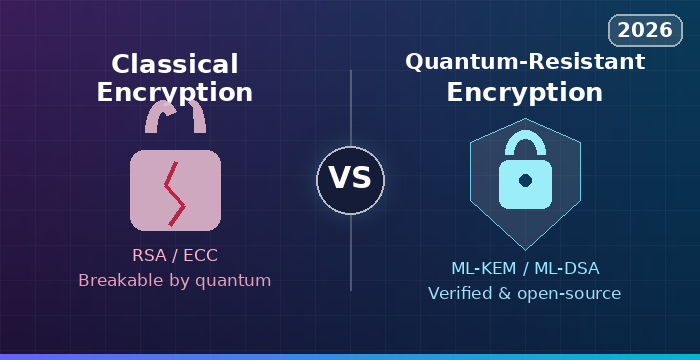
Most of the security you rely on every day rests on public-key cryptography — systems like RSA and elliptic-curve cryptography. These schemes are safe against ordinary (classical) computers because breaking them would take an absurd, impractical amount of computing time.
Quantum computers change the math. A sufficiently advanced quantum machine could run algorithms — most famously Shor's Algorithm — that crack those same schemes in a tiny fraction of the time. The encryption is not "hard" for a quantum computer in the same way it is hard for a classical one.
Two things make this urgent rather than academic:
-
The timeline is uncertain but the direction is not. Practical, large-scale quantum attacks may be years away, but most governments and security teams now treat them as inevitable, not hypothetical.
-
"Harvest now, decrypt later" collapses the timeline. An adversary does not need a quantum computer today to threaten today's secrets. They only need to store today's encrypted traffic and wait.
That is why the migration to post-quantum cryptography (PQC) is happening now, well ahead of any working quantum attack.
The Two Algorithms at the Center: ML-KEM and ML-DSA
Apple's post-quantum work is built around two standards selected by the U.S. National Institute of Standards and Technology (NIST) after years of open international competition:
| Algorithm | Full Name | What It Does |
|---|---|---|
| ML-KEM | Module-Lattice Key Encapsulation Mechanism | Helps two parties establish a shared secret key securely (FIPS 203) |
| ML-DSA | Module-Lattice Digital Signature Algorithm | Produces digital signatures that prove authenticity (FIPS 204) |
These were chosen for a practical mix of reasons: strong resistance to quantum attacks, good performance, relatively compact key and ciphertext sizes, compatibility with existing systems, and a solid mathematical foundation. In short, they are not just secure on paper — they are deployable at scale.
The Genuinely New Idea: Formal Verification
Here is where Apple's announcement gets interesting beyond "company posts code on the internet."
Normal software testing checks a selection of scenarios. You write test cases, you run them, and if they pass you gain confidence. But you have only checked the cases you thought of.
Formal verification is different in kind. It uses mathematics to prove that the software behaves correctly under all specified conditions — not just the ones a tester remembered to write down. In cryptography, where a single subtle flaw can quietly undermine an entire system, that distinction is enormous.
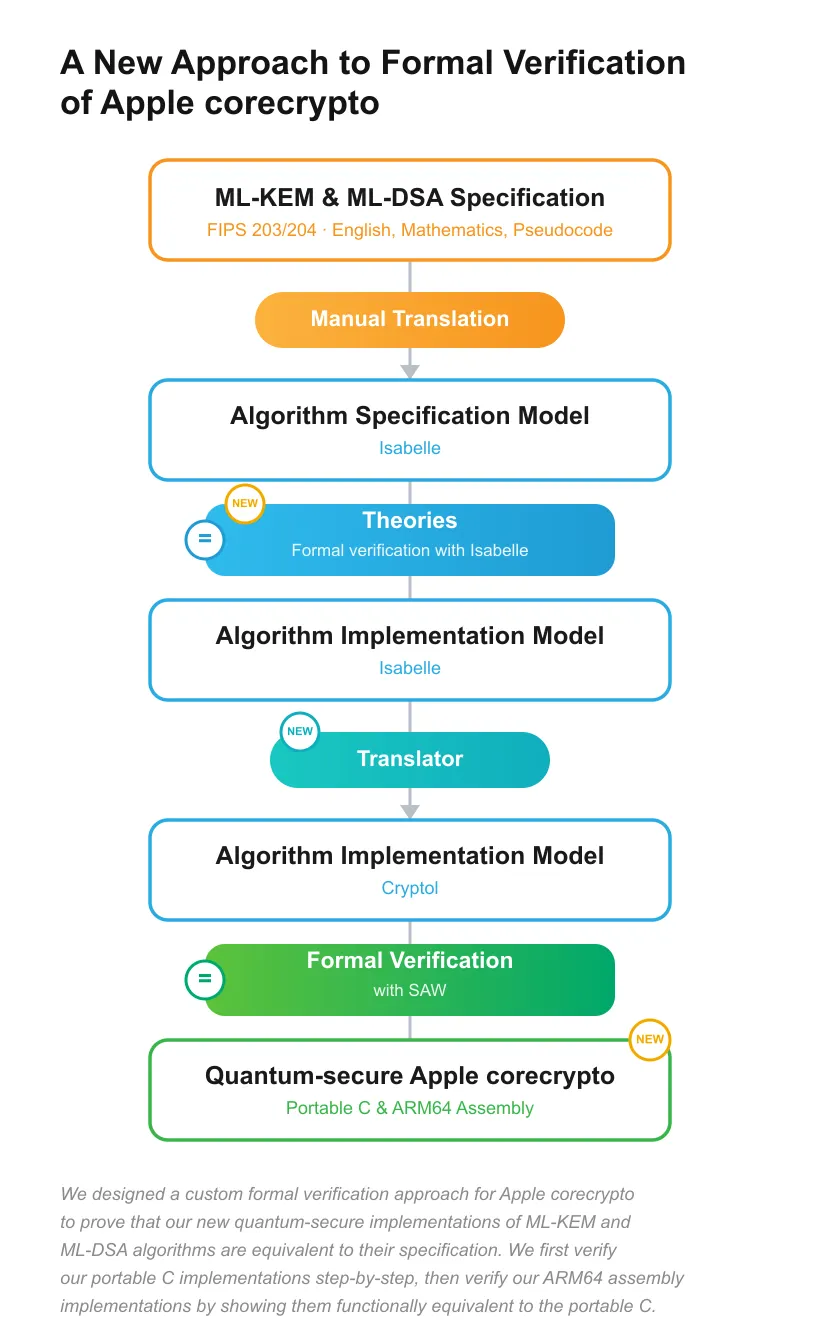
Apple found that off-the-shelf verification tools did not fully fit its needs, so its engineers — working with Galois, a firm that specializes in high-assurance verification — built a custom pipeline. At a high level, the toolchain:
-
Translates models written in Cryptol into Isabelle theories (Isabelle is a proof assistant — software that helps construct and check mathematical proofs).
-
Connects the portable C implementation to those Cryptol specifications.
-
Uses SAW (the Software Analysis Workbench) to tie the actual code to the proofs.
-
Verifies the whole thing against the official FIPS 203 / FIPS 204 standards.
-
Even covers hand-optimized ARM64 assembly, by proving it is functionally equivalent to the portable C.
The scale is worth pausing on: the resulting proofs reportedly required more than 50,000 individual proof steps. This is not a checkbox. It is an enormous, multi-layered mathematical argument made public.
The verification flow, simplified
FIPS 203/204 spec (English, math, pseudocode)
        |  manual translation
        v
Algorithm Specification Model (Isabelle)
        =  proven equivalent
Algorithm Implementation Model (Isabelle / Cryptol)
        =  proven equivalent
Portable C implementation
        =  proven equivalent
ARM64 assembly implementation
Each "=" is not a hope. It is a proof.
The Bug That Testing Would Have Missed
Apple shared a concrete payoff. In an early implementation of ML-DSA, the verification process caught a missing computational step that, in rare circumstances, could let certain inputs exceed their expected numerical limits and produce incorrect output. Conventional testing very likely would have sailed right past it.
The fix landed before the code ever shipped publicly. The lesson is uncomfortable but important: implementing advanced cryptography correctly can be just as hard as designing the algorithms in the first place. The math being sound does not guarantee the code is.
A Step-by-Step Walkthrough: Exploring the Release Safely
This section is for the hands-on reader who wants to actually look at what Apple published, rather than just read about it. Everything below is local research work on your own machine. You do not need a production server, and you should not put any of this near one (see the caution section at the end).
Throughout, I use a fictional engineer named Alex Rivera working on a throwaway laptop, with placeholder values like [email protected] and a sample working directory ~/research/pqc-lab. None of these are real credentials — substitute your own as needed.
Step 1 — Set up an isolated workspace first
Before cloning anything, give yourself a clean sandbox. Doing this first keeps experimental crypto code well away from the rest of your system.
# 1st: create an isolated directory for the experiment
mkdir -p ~/research/pqc-lab
cd ~/research/pqc-lab
Step 2 — Clone the public repository
Apple published the work to its public GitHub organization. Cloning is read-only; you are pulling a copy, not changing anything upstream.
# 2nd: clone the public source (no credentials needed for a public repo)
git clone https://github.com/apple/corecrypto.git
cd corecrypto
If you prefer authenticating with your own account, configure Git with placeholder values you control — for example
git config user.email "[email protected]"— never with shared or production credentials.
Step 3 — Locate the formal verification material
The interesting part of this release is not just the crypto code; it is the dedicated verification folder containing the proofs and tooling.
# 3rd: find the verification and technical overview content
ls -la
find . -type d -name "*verify*"
Step 4 — Read before you run
Read the technical overview documentation before attempting to build or run anything. Proof tooling like Isabelle, Cryptol, and SAW each has its own setup requirements, and reading first saves hours.
# 4th: skim the technical overview and any README files
find . -iname "*.md" | head
Step 5 — Reproduce in a disposable environment
If and only if you want to actually run the proofs, do it inside a disposable virtual machine or container, not on your daily-driver OS. Treat the whole thing as untrusted-until-verified, even though it comes from a reputable source. The point of an isolated environment is that you can throw it away cleanly when you are done.
Why no production server here? This is the one place worth being explicit: there is no legitimate reason to run experimental cryptographic research code on a production server. Production crypto should come from properly released, audited, version-pinned libraries through your platform's normal channels — not from a research checkout. The walkthrough above is for learning and auditing, full stop.
How This Fits the Bigger Industry Picture
Apple is not acting alone, and it is not first. The whole industry is shifting:
-
Google has experimented with post-quantum protections in its browser and internal networking.
-
Microsoft has folded quantum-safe cryptography into parts of its operating system and cloud research environments.
-
IBM has been a long-running force in both quantum computing and post-quantum standards.
-
Governments are pushing too: U.S. federal agencies have been directed to begin migrating to post-quantum standards, and security agencies worldwide keep warning organizations not to wait.
What stands out about Apple's contribution is not the algorithms — those are the shared NIST standards everyone is adopting — but the transparency of the assurance. Opening up the proofs and the proof tooling is the unusual part.
Open Source as a Security Strategy
For a company historically known for tight control over its software, choosing to open-source this is a philosophical statement. In cryptography, secrecy is a weak foundation. The strongest systems are the ones that have survived sustained public scrutiny.
By exposing both the code and the mathematical proofs, Apple is leaning into that principle: invite the experts to attack it, and the system that survives is the one you can trust. Apple has framed its own view roughly as: the strongest assurance comes from combining formal verification with conventional methods and then critically judging the end-to-end result. No single technique is treated as a silver bullet.
Conclusion
The headline is simple. A company responsible for the cryptography on billions of devices has not only deployed post-quantum protection — it has published the proof that the protection is implemented correctly, and the tools for anyone to check that proof. In a field where trust is everything and "trust me" is worthless, that is a meaningful step.
But it is a step, not a finish line. Quantum-capable attackers are not here yet; the hard work of migrating the entire internet — software, hardware, authentication, protocols — will take years. The value of moves like this one is that they happen before the threat is operational, while there is still time to get it right.
Merits
-
Independent verifiability. Outside researchers can now audit and reproduce the correctness claims rather than taking them on faith.
-
Higher industry baseline. Publishing the verification tooling could pull the whole field toward stronger assurance standards.
-
Real bug-catching power. Formal verification already caught a flaw conventional testing would likely have missed.
-
Proactive timing. Defenses are being built ahead of the threat, which is exactly the right order.
Demerits and Limitations
-
Not a complete guarantee. Formal verification still rests on assumptions — for example, that the compiler is correct — and some parts reportedly still lean on conventional testing due to tooling limits.
-
Steep barrier to entry. Genuinely auditing this work requires deep expertise in proof assistants and cryptography; most people will rely on the small community that can.
-
Deployment is the hard part. Correct algorithms and proofs do not solve the enormous logistical challenge of rolling post-quantum crypto across billions of devices and legacy systems.
-
Verification is not a security panacea. Proving functional correctness does not, by itself, eliminate every class of attack (side channels, key management failures, and so on).
Caution — Do This at Your Own Risk
Everything in the step-by-step walkthrough is for learning and independent research only. Do not roll your own cryptography for anything real, and do not deploy experimental or research-checkout code into production. Use vetted, officially released, version-pinned libraries through your platform's normal channels for any system that actually protects data. Run experimental code only in disposable, isolated environments. Cryptography is unforgiving: a small mistake can silently undo all of it. Proceed at your own risk.
These are the questions readers are most likely searching for around this topic — useful as headers, FAQ entries, or "People Also Ask" targets:
- What did Apple open-source about its quantum-resistant encryption?
- What is post-quantum cryptography and why does it matter in 2026?
- What are ML-KEM and ML-DSA, and how are they different?
- What is the "harvest now, decrypt later" attack?
- How does formal verification differ from normal software testing?
- What is Apple's corecrypto library and what does it protect?
- Can quantum computers break RSA and elliptic-curve encryption?
- What is Shor's Algorithm and why is it a threat to encryption?
- What are FIPS 203 and FIPS 204?
- Who is Galois and what role did they play in Apple's verification?
- What proof tools did Apple use (Cryptol, Isabelle, SAW)?
- How can researchers audit Apple's post-quantum cryptography code?
- Is post-quantum cryptography ready for production use?
- How are Google, Microsoft, and IBM approaching post-quantum security?
- When will quantum computers be able to break current encryption?
#PostQuantumCryptography #QuantumComputing #AppleSecurity #Cybersecurity #Encryption #corecrypto #MLKEM #MLDSA #FormalVerification #QuantumSafe #PQC #InfoSec #NISTStandards #FIPS203 #FIPS204 #OpenSource #CryptographyResearch #ShorsAlgorithm #HarvestNowDecryptLater #DataPrivacy #QuantumResistant #DigitalTrust #SecurityResearch #Cryptol #Isabelle
This article is an independent explainer written for a general technical audience. All step-by-step examples use fictional names and placeholder values and are for educational purposes only.
Docker Security Checklist
Lock down your containers from build to runtime — 29 practical controls covering images, runtime flags, secrets, and the daemon. Enter your email — you'll get the PDF instantly, plus new posts on Docker, Linux & security.
Free. No spam — unsubscribe in one click.
Responses
Sign in to leave a response.