
🎧 Listen to this article: English
🌍 Read this in your language: हिंदी · தமிழ் · తెలుగు · ಕನ್ನಡ · മലയാളം · ଓଡ଼ିଆ · 日本語 · 中文
Pointers can be a bit scary at first, especially if you're coming from languages like JavaScript, Python, or Java, where memory management is automatic. But don't worry! Understanding pointers in Go is simpler than it seems.
Knowing how to work with pointers is important as developers are increasingly using Go for backend development. Let's dive into the basics.
What Are Pointers?
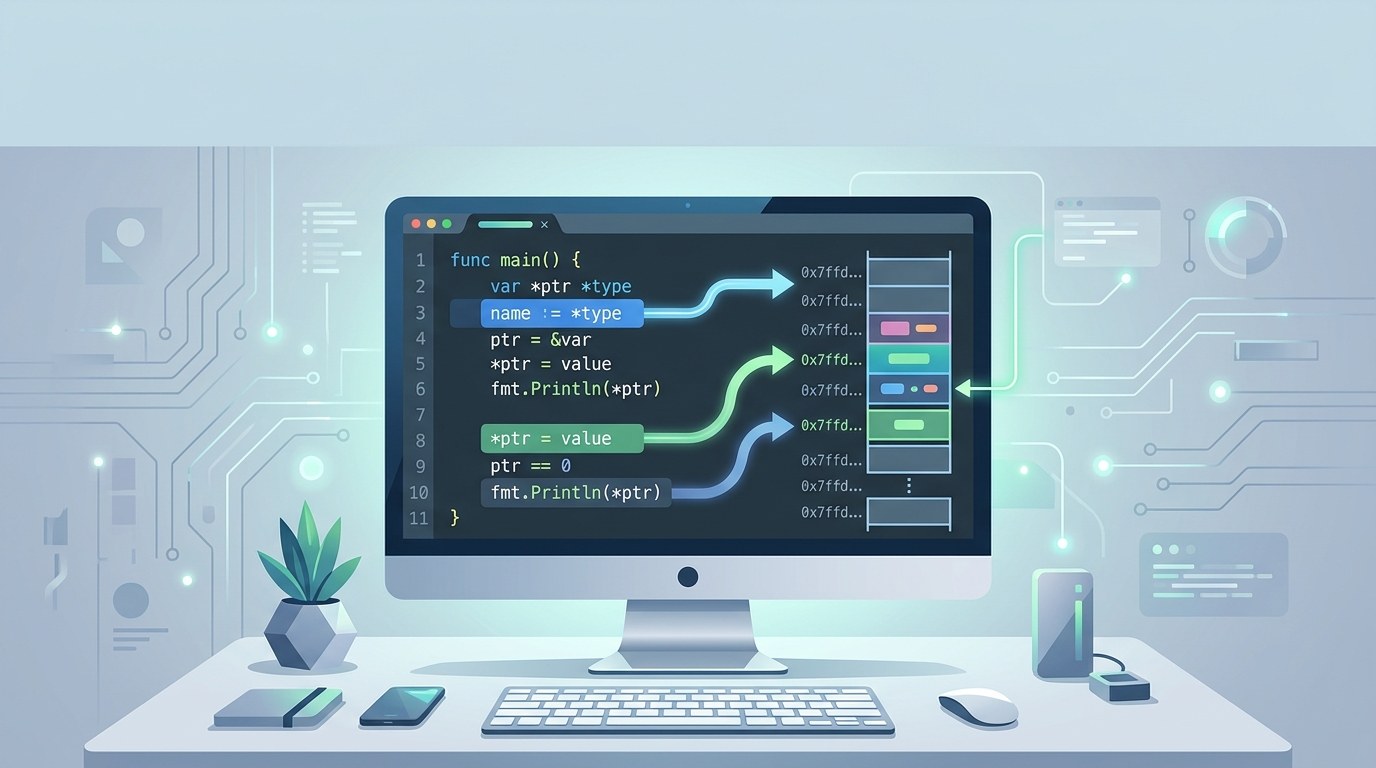
In Go, a pointer is a special type of variable. Instead of storing a value directly, a pointer holds the memory address of another variable. Every variable in a program occupies a space in memory, and that space has a unique address.
For example, if you have a variable x that holds the value 10, you can create a pointer p that points to x's address. Here's how it works:
x := 10
p := &x
fmt.Println(*p) // Outputs: 10
In this code:
xholds the value10.pis a pointer that stores the address ofx(using the&operator).*pdereferences the pointer, allowing you to access the value stored at that address, which is10.
Key Operators
When working with pointers, there are two crucial operators to remember:
&: This operator is used to get the address of a variable. For example,&xgives you the address wherexis stored.*: This operator dereferences a pointer, meaning it accesses or modifies the value at the address the pointer points to. For instance,*pgives you the value ofx.
Why Use Pointers?
Pointers are particularly useful in several scenarios:
- Modifying Original Values: When you want to change the value of a variable inside a function, you can pass a pointer to that variable. This way, the function can modify the original value instead of a copy.
For instance:
func changeName(user *User) {
    user.Name = "João"
}

user := User{Name: "Lucas"}
changeName(&user)
fmt.Println(user.Name) // Outputs: João
In this example, the function changeName receives a pointer to user, allowing it to change the original user's name.
-
Sharing Large Data Structures: If you have large data structures, passing pointers can save memory and improve performance. Instead of copying the entire structure, you can just pass the pointer.
-
Implementing Data Structures: Pointers are essential for creating complex data structures like linked lists or trees, where elements point to each other.
Practical Example
Let's say you're building an API. You might create a single instance of a database connection that multiple repositories can share:
db, _ := sql.Open("postgres", dsn)
userRepo := NewUserRepository(db)
orderRepo := NewOrderRepository(db)
In this case, both userRepo and orderRepo can use the same database connection, which is efficient and avoids unnecessary copies.
Best Practices
A good rule of thumb is to use values by default. Use pointers when you need to:
- Share or modify the same instance of data.
- Represent a null value (nil).
- Avoid copying large or complex data structures.
Conclusion
Understanding pointers in Go opens up new possibilities for efficient programming. They allow you to manipulate data without unnecessary duplication, making your applications faster and more memory-efficient.
Merits
- Efficient memory usage by avoiding unnecessary copies.
- Ability to modify original variables within functions.
- Essential for implementing complex data structures.
Demerits
- Can be confusing for beginners.
- Requires careful management to avoid errors, such as dereferencing a nil pointer.
Caution
This article is meant for educational purposes. Always replace any placeholder values with actual data in your code. Make sure to verify any claims against the original source before relying on them.
Frequently asked questions
- What is a pointer in Go? — A pointer is a variable that stores the memory address of another variable instead of its value.
- How do I create a pointer in Go? — You create a pointer by using the
&operator to get the address of a variable. - What does the
*operator do? — The*operator dereferences a pointer, allowing you to access or modify the value at the address it points to. - Why should I use pointers? — Pointers allow you to modify original variables in functions and share large data structures without copying them.
- Can pointers be nil? — Yes, pointers can be nil, which means they do not point to any memory address.
- What are some common mistakes with pointers? — Common mistakes include dereferencing nil pointers or forgetting to use pointers when needed, leading to unexpected behavior.
Tags
#go #programming #tutorial #backend #memorymanagement #pointers #coding #softwaredevelopment
Incident Response: First Hour
A calm, evidence-preserving checklist for establishing control, bounding impact, communicating clearly, and containing an incident safely.
Free. No spam — unsubscribe in one click.
Responses
Sign in to leave a response.