
🎧 Listen to this article: English
🌍 Read this in your language: हिंदी · தமிழ் · తెలుగు · ಕನ್ನಡ · മലയാളം · ଓଡ଼ିଆ · 日本語 · 中文
A viral search query recently asked whether Elon Musk had purchased "Mathrubhumi." That curious question was actually a phonetic transcription error for the Odia word "ମରୁଭୂମି" (Marubhumi), which literally translates to desert or arid land. The real underlying question was simple and striking: why are Elon Musk's companies aggressively buying up thousands of acres of desert, sandy soil, and coastal flats across the American Southwest?
On November 24, 2026, the scale of this corporate land acquisition has become clear. Over the past month, SpaceX, Tesla, and xAI have committed more than 74 billion dollars toward industrial infrastructure projects across Arizona and Texas. These investments include a 50 billion dollar artificial intelligence supercomputing campus in the Arizona desert, a 24 billion dollar compute hub with a dedicated gas plant near the Gulf of Mexico, and contentious land swaps around the Starbase rocket facility. Understanding this land campaign reveals how frontier artificial intelligence and orbital rocketry have converged into an urgent competition for physical space, electrical generation, and water rights.
From "ମରୁଭୂମି" (Desert) to Transcription Error: What Is Being Bought?
In Odia and related Indic languages, "ମରୁଭୂମି" (pronounced Marubhumi) translates directly to desert or arid wilderness—combining maru (arid or barren) with bhumi (land or earth). When speech recognition engines, search algorithms, and automated voice tools processed spoken queries asking why Elon Musk was buying vast stretches of "marubhumi" (deserts), automated transcription models misheard the phonetic sound and auto-corrected it into "Mathrubhumi"—a century-old Indian daily newspaper and media organization founded in 1923 during the independence movement.
Neither Elon Musk nor any of his companies has acquired or attempted to acquire a media publication. However, in the literal sense of buying "ମରୁଭୂମି"—inhospitable desert terrain, sun-drenched arid basins, and sandy coastal mudflats—Musk's corporate network has embarked on an unprecedented acquisition campaign.
In South Texas, federal and state land exchanges have transferred hundreds of acres of wildlife refuge land adjacent to historic Indigenous sites into private hands. In the Arizona desert, massive utility arrangements aim to draw nearly a fifth of a state's current generating capacity for private compute clusters. The real story behind the query is not a media buyout, but an aggressive physical and electrical re-engineering of the American desert.
The Twin AI Supercomputing Hubs: Arizona and South Texas
Training frontier artificial intelligence models requires immense electricity and contiguous acreage. To bypass multi-year utility interconnection queues, SpaceX announced twin supercomputing projects in mid-November 2026 totaling 74 billion dollars. While both facilities target hyperscale AI training, they adopt opposite power architectures.
The 50 Billion Dollar Cochise County Campus in Arizona
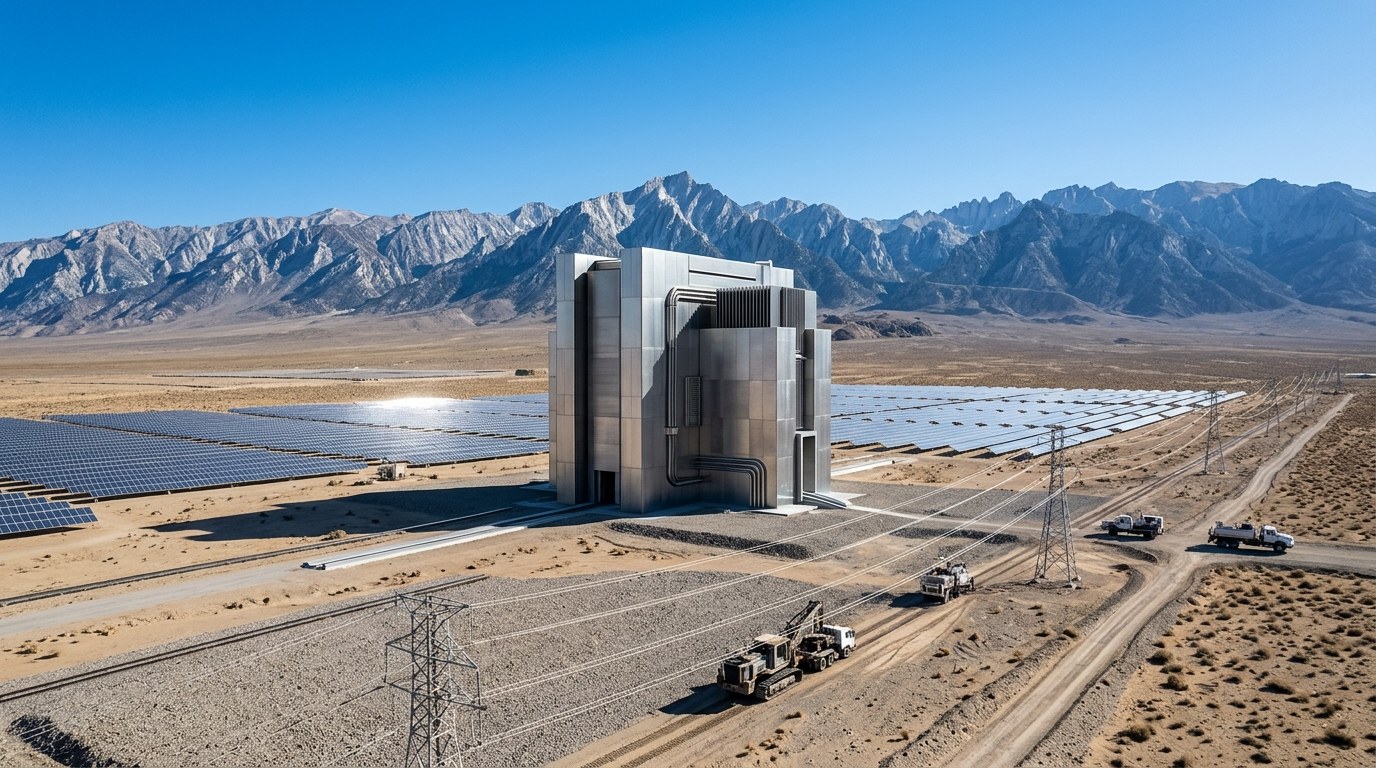
In southeastern Arizona, SpaceX selected 747 acres near the Willcox Playa in Cochise County to construct a nine-building artificial intelligence campus. The project relies on a massive grid-connected utility model.
SpaceX plans to draw up to 6,000 megawatts, or 6 gigawatts, of electricity from local utility cooperatives, specifically the Sulphur Springs Valley Electric Cooperative and the Arizona Electric Power Cooperative. That single load represents roughly 20 percent of Arizona's entire current electrical generating capacity.
To support this demand, SpaceX pledged 3.6 billion dollars in regional grid and substation upgrades. It also committed to install a 24 gigawatt-hour battery storage bank, projecting that these investments could reduce electricity bills for cooperative members by 10 to 40 percent.
However, state regulators have raised concerns. Arizona Attorney General Kris Mayes requested that the Cochise County Planning Commission postpone its scheduled December 9, 2026 vote until state and federal authorities evaluate the strain on the public grid. Regulators want guarantees that local ratepayers will not be burdened with stranded transmission costs if AI hardware demand shifts.
Water supply is an equally urgent issue in the drought-stressed Willcox basin. SpaceX pledged zero industrial groundwater pumping, zero new wells, and a closed-loop dry-cooling system that recirculates treated water for up to ten years, supplemented by wastewater from the Apache Generating Station. However, state officials noted that the proposal omits the indirect water consumed by off-site power plants generating the 6 gigawatts of continuous power.
The 24 Billion Dollar Starbase Campus in Texas
In Cameron County, Texas, near the Port of Brownsville and the Starbase spaceport, SpaceX selected an alternative energy strategy. Rather than relying on the public electric grid managed by ERCOT, SpaceX opted for complete self-generation.
On November 16, 2026, SpaceX secured an air permit from the Texas Commission on Environmental Quality authorizing the installation of 35 natural gas turbines totaling 750 megawatts of generating capacity on 444.45 acres. By building its own behind-the-meter gas plant, SpaceX bypassed ERCOT interconnection queues.
The trade-off is environmental impact. The state air permit authorizes the gas turbines to emit up to 248 tons of nitrogen oxides per year near coastal wetlands. Civic coalitions, including the South Texas Environmental Justice Network, have protested the emissions footprint.
SpaceX also navigated local regulatory boundaries. To avoid a 90-day data center moratorium enacted by the city of Brownsville, SpaceX arranged for Brownsville to de-annex the 444.45-acre tract on August 29, 2026, allowing the neighboring municipality of Starbase to annex it. SpaceX committed 220 million dollars, including an immediate 40 million dollar payment, to the Brownsville Public Utilities Board for water reuse and brackish groundwater desalination projects producing 18 to 20 million gallons daily. Meanwhile, on November 17, 2026, Cameron County commissioners voted 3 to 2 against negotiating a 10-year, 100 percent property tax abatement requested by SpaceX.
The Boca Chica Coastal Buffer Battles
While inland desert acreage hosts data centers, coastal sand flats and mudflats serve a different requirement: rocket launch safety. SpaceX's Starship is the largest rocket ever built. Launching and testing engines at that scale produces intense sound, vibration, and thermal plumes.
To operate safely, SpaceX requires an expansive perimeter around its launchpads at Boca Chica Beach. However, the site is bordered by the Gulf of Mexico, the Rio Grande, residential homes, and public nature preserves.
Buyouts and State Park Swaps
SpaceX began by buying out homes in Boca Chica Village, offering residents up to three times appraised fair market value. While many homeowners accepted, several held out, reporting heavy construction noise, ground vibrations from static engine tests, and recurring evacuation notices. Because State Highway 4 is the only road to Boca Chica Beach, rocket tests frequently close public access, creating friction with beachgoers protected under the Texas Open Beaches Act.
To expand its perimeter, SpaceX pursued public land swaps. In March 2024, the Texas Parks and Wildlife Department approved an exchange granting SpaceX 43 acres of state parkland near the launchpad in return for 477 acres near the Laguna Atascosa National Wildlife Refuge. In late 2026, leaked records revealed that SpaceX proposed purchasing an additional 1,200 acres of state parkland surrounding Starbase, offering to place 600 acres elsewhere under conservation protection.
The Federal Refuge Lawsuit
The sharpest conflict involves a federal land exchange finalized on October 5, 2026. The U.S. Fish and Wildlife Service transferred 715 acres of the Lower Rio Grande Valley National Wildlife Refuge to SpaceX in exchange for 683 acres of private coastal habitat.
A legal coalition filed a federal lawsuit challenging the exchange. The case, Center for Biological Diversity v. Nesvik, was brought by the Center for Biological Diversity, Save RGV, the South Texas Environmental Justice Network, and the Carrizo/Comecrudo Nation of Texas in the U.S. District Court for the Southern District of Texas.
The lawsuit challenges the transfer under four primary federal statutes:
- National Wildlife Refuge System Improvement Act: The plaintiffs argue that federal law requires land exchanges to provide a net conservation benefit to the specific refuge altered, rather than using distant land offsets.
- National Environmental Policy Act: The agency issued a Finding of No Significant Impact based on a limited Environmental Assessment rather than preparing a full Environmental Impact Statement that evaluates industrial lighting, noise, and rocket debris.
- National Historic Preservation Act: Approximately 700 acres of the transferred land overlap with the Palmito Ranch Battlefield National Historic Landmark, the site of the final battle of the American Civil War. The Carrizo/Comecrudo Nation asserts that the delta contains ancestral burial grounds transferred without mandatory tribal consultation.
- Endangered Species Act: The clearing of coastal flats fragments critical habitat for protected species, including the piping plover, the ocelot, and the Kemp's ridley sea turtle.
On September 21, 2026, U.S. District Judge Rolando Olvera denied a motion for a preliminary injunction, allowing the title transfer to close on October 5. However, the underlying statutory claims remain active in court.
Tesla's Desert Solar Agreements and Vertical Integration
Acquiring desert land is also tied directly to energy harvesting. Arid regions provide the highest solar irradiance in North America, making them ideal for utility-scale solar generation.
Rather than building every solar field itself, Tesla has executed long-term Power Purchase Agreements with independent developers to power its AI clusters and manufacturing plants.
In July 2026, Tesla signed a landmark contract with developer ContourGlobal for Project Sterling in the Arizona desert. The 2,000-acre facility combines 760,000 solar panels generating 509 megawatts of direct current with a 360-megawatt, 1.4-gigawatt-hour lithium iron phosphate battery storage system. Tesla contracted to purchase 90 percent of the output, amounting to roughly one terawatt-hour of electricity annually.
Because desert solar peaks at midday while AI clusters operate continuously, the four-hour battery bank enables clean electricity dispatch for up to 16 hours a day. Groundbreaking began in October 2026, with commercial operations targeted for 2028.
Tesla also signed a power purchase agreement with renewables firm Zelestra for Lumen Farm in Anderson County, Texas, securing 100 percent of the plant's 140 megawatts of alternating current capacity starting in 2029.
Alongside energy off-take contracts, Tesla is constructing a vertically integrated domestic solar supply chain in Texas. This includes Project Crystal Sun, a proposed 10 billion dollar, 100-gigawatt-per-year integrated solar panel plant near Houston, and a 3.1 billion dollar solar-grade polysilicon refinery near Robstown, Texas. By controlling silicon processing, panel manufacturing, and battery storage, Musk's companies aim to insulate their compute clusters from volatile energy markets.
Practical Walkthrough: Auditing AI Infrastructure Footprints
To understand how enterprises evaluate these massive power and land requirements, consider a scenario at the fictional company Acme. The worked walk-through below is an illustrative scenario showing how an engineering team evaluates deploying compute in arid regions versus established data centers.
At Acme, leadership faces rising computational demands for neural network training. B SOUMYA PRAKASHINEE (CEO) directs the engineering team to assess whether Acme should lease space in an emerging desert compute cluster or build a self-contained facility. Rohit (DevSecOps) audits power draw, thermal loads, and generation feasibility. Malaya (Cyber Security) examines physical site boundaries, grid dependency, and environmental compliance.
+-----------------------------------------------------------------------+
|                       ACME INFRASTRUCTURE AUDIT                       |
|                                                                       |
|  [Step 1] Compute & Thermal Modeling  --> Rohit (DevSecOps)           |
|  [Step 2] Grid vs. Behind-the-Meter   --> Rohit & Malaya              |
|  [Step 3] Water & Cooling Assessment  --> Cross-Functional Review     |
|  [Step 4] Environmental & Perimeter   --> Malaya (Cyber Security)     |
+-----------------------------------------------------------------------+
Step 1: Model Continuous Compute and Peak Cooling Loads
Rohit begins by calculating the power density of Acme's proposed training cluster. High-performance graphics processing units generate intense thermal loads that require reliable cooling.
Rohit models an illustrative cluster requiring 12 megawatts of continuous power for compute silicon alone. Under high ambient desert temperatures, cooling systems consume significant extra power.
# Illustrative calculation script executed by Rohit (DevSecOps)
# Models Power Usage Effectiveness (PUE) across ambient temperature swings
python3 -c '
base_compute_kw = 12000.0
ambient_temp_c = 42.0  # Summer desert conditions

# In high ambient heat, dry-cooling efficiency drops, increasing fan overhead
cooling_overhead = 0.15 if ambient_temp_c < 30.0 else 0.32
total_facility_kw = base_compute_kw * (1.0 + cooling_overhead)
pue = total_facility_kw / base_compute_kw

print(f"Total Facility Load: {total_facility_kw:.2f} kW")
print(f"Calculated Operational PUE: {pue:.2f}")
'
The sample output shows an operational Power Usage Effectiveness of 1.32 during peak heat. Rohit notes that while desert land is inexpensive, ambient heat above 40 degrees Celsius creates cooling overheads that must be factored into operating costs.
Step 2: Evaluate Grid Interconnection Against Behind-the-Meter Generation
Next, Rohit compares utility grid connection timelines against on-site gas generation. Connecting to the public electric grid requires substation upgrades and up to four years in interconnection queues.
Conversely, installing on-site natural gas turbines allows faster deployment but introduces fuel price exposure, pipeline dependencies, and emissions permitting constraints. Rohit notes that while on-site generation bypasses grid queues, it requires continuous emissions monitoring systems to comply with clean air standards.
Step 3: Audit Direct and Indirect Water Consumption
The team then evaluates water consumption. In arid basins, public pushback against industrial water use can delay or halt projects.
Rohit and Malaya examine closed-loop dry cooling versus evaporative cooling. While dry cooling eliminates direct groundwater consumption, it forces equipment to consume more electricity during hot weather. Malaya notes that if the utility burns coal or gas to supply that extra electricity, the facility's indirect water consumption remains substantial. The team concludes that any desert facility must secure contractual access to treated municipal wastewater rather than tapping local aquifers.
Step 4: Verify Environmental Compliance and Boundary Security
Finally, Malaya conducts a physical and regulatory security review. Remote rural campuses present distinct operational challenges.
Malaya evaluates fiber optic backhauls across remote desert areas, verifying that redundant physical paths exist to prevent single-point cable cut failures. Furthermore, Malaya confirms that the site does not encroach upon protected ecological corridors or contested public lands, which could expose the enterprise to legal injunctions.
Malaya and Rohit present their findings to B SOUMYA PRAKASHINEE (CEO). The report recommends that Acme avoid direct ownership of contested rural land and instead partner with established data centers that utilize diversified solar-plus-storage energy contracts.
Conclusion
The expansion of Elon Musk's industrial footprint across Arizona and Texas highlights the massive physical demands of frontier computing and rocketry. Artificial intelligence is an industrial consumer of acreage, electrical capacity, and water infrastructure. While SpaceX and Tesla have moved rapidly to assemble land and energy contracts, their initiatives increasingly intersect with community water rights, public utility stability, and environmental protections. Balancing technological growth with sustainable local stewardship will determine the future of these major industrial developments.
Merits
- Secures massive electrical capacity required to train frontier artificial intelligence models.
- Pairs high-intensity compute clusters with large-scale solar generation and battery storage systems.
- Stimulates rural economies through multi-billion-dollar investments in transmission lines and substations.
- Expands orbital launch capabilities by establishing safe operational buffers around rocket facilities.
- Fosters domestic supply chain integration from raw polysilicon refining to finished solar panels.
Demerits
- Places substantial strain on regional utility grids, demanding significant portions of state generating capacity.
- Generates air emissions when developers install on-site gas turbines to bypass transmission queues.
- Increases competition for scarce groundwater resources in severely drought-stressed desert basins.
- Encroaches on sensitive wildlife habitats, coastal wetlands, and ancestral Indigenous heritage sites.
- Creates community friction regarding public beach closures, heavy industrial noise, and tax abatements.
Caution
This article is prepared strictly for educational, informational, and analytical purposes based on public filings, regulatory records, court documents, and reporting available as of November 2026. Real estate transactions, utility tariffs, litigation outcomes, and environmental permits remain subject to legal and regulatory developments. Organizations and individuals should independently verify official records before making financial, architectural, or legal decisions.
Frequently asked questions
- Did Elon Musk purchase Mathrubhumi or any Indian media house? — No, the viral query was an automated phonetic transcription error for the Odia word "ମରୁଭୂମି" (Marubhumi), which means desert or arid land.
- Why is Elon Musk buying "ମରୁଭୂମି" (deserts) and sandy land? — Musk's companies are buying arid desert acreage and coastal flats for gigawatt-scale solar fields, massive AI supercomputing centers, and safety buffer zones for Starship rocket launches.
- What is SpaceX constructing in Cochise County, Arizona? — SpaceX announced plans for a 50 billion dollar artificial intelligence supercomputing campus across 747 acres near Willcox Playa, drawing up to 6 gigawatts of power.
- How is SpaceX powering its 24 billion dollar data center in South Texas? — The site utilizes an on-site, behind-the-meter power plant powered by 35 natural gas turbines authorized to produce up to 750 megawatts.
- What is the controversy surrounding Boca Chica State Park and the wildlife refuge? — Environmental organizations and Indigenous groups have challenged land swaps in federal court, arguing that transferring public refuge land to SpaceX harms wildlife and sacred sites.
- What is Tesla's Project Sterling in Arizona? — Project Sterling is a 2,000-acre hybrid energy project combining 509 megawatts of solar panels with 1.4 gigawatt-hours of battery storage, with Tesla purchasing 90 percent of its electricity.
- Why did state officials in Arizona express concern over the Cochise County project? — Arizona Attorney General Kris Mayes requested a review delay to ensure the facility's 6-gigawatt power draw does not strain the electrical grid or burden local utility ratepayers.
Tags
#ElonMusk #SpaceX #Tesla #AIDataCenters #SolarEnergy #CleanTech #Starbase #EnergyTransition #BigTech #Infrastructure
Kubernetes Security Checklist
Harden cluster access, workload identity, pod security, network boundaries, software supply chain, secrets, and operational monitoring.
Free. No spam — unsubscribe in one click.
Responses
Sign in to leave a response.